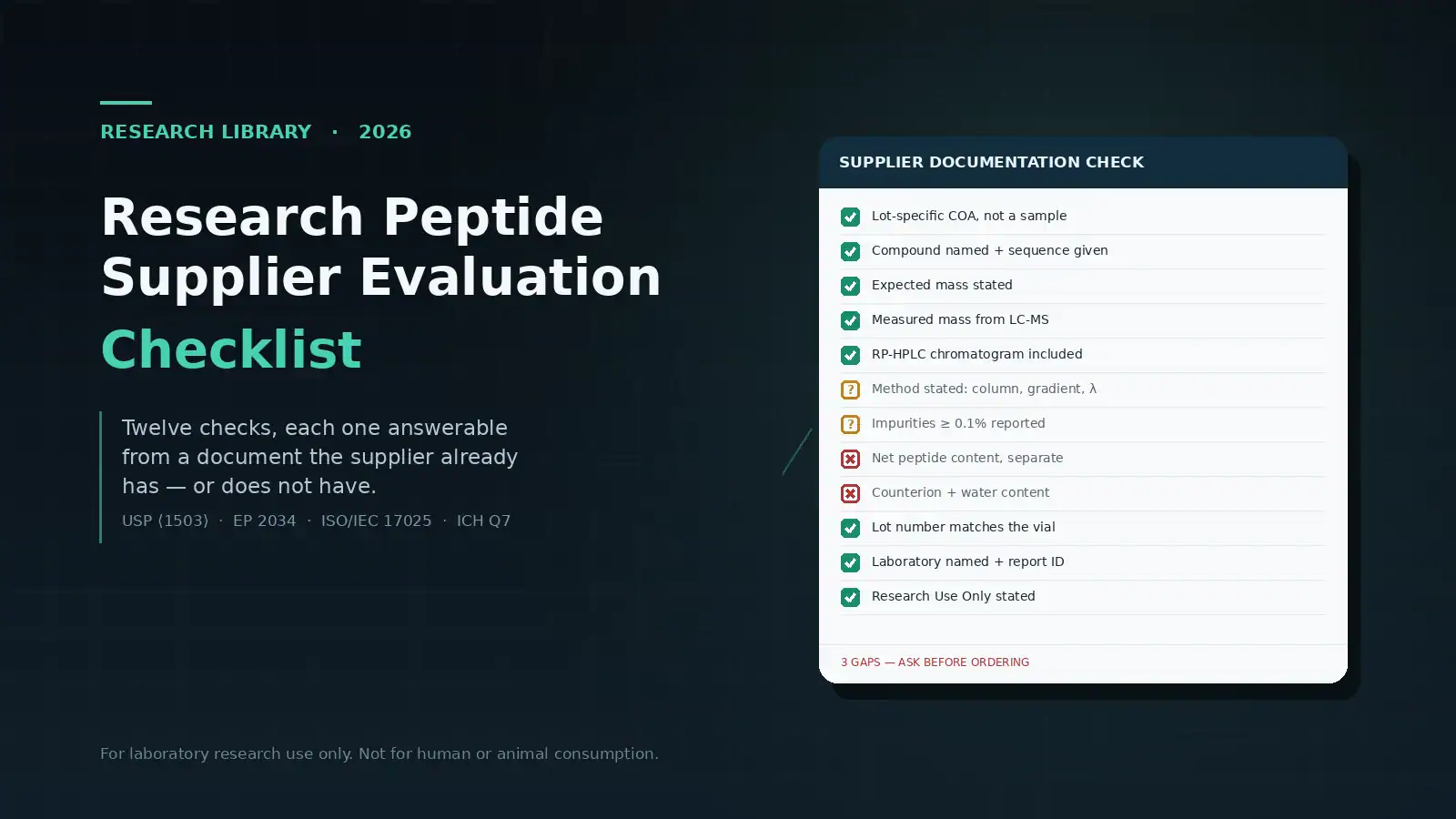

Every line on this checklist is answerable from a document the supplier either has or does not have.
Choosing a research peptide supplier is usually framed as a question about trust. It is better framed as a question about documents.
Trust is unfalsifiable. A document either states an expected mass or it does not. A lot number on a certificate either matches the number on your vial or it does not. A testing laboratory either has a verifiable report reference or it does not. Those are binary, checkable, and they do not require you to form a view about anyone’s character.
Peptides Exchange sells research peptides, so apply every check below to us as readily as to anyone else — and near the end of this article we work through our own current certificate and name the places it falls short.
New to this material? Start with What Are Research Peptides? and Peptide Certificate of Analysis: How to Read a COA.
Why rankings are the wrong tool
Search for the best research peptide supplier and nearly every result is published by a company that sells peptides, or by an affiliate paid when you buy.
That is not only an editorial problem. The Federal Trade Commission’s Rule on the Use of Consumer Reviews and Testimonials, 16 CFR Part 465, effective October 2024, prohibits fake and misattributed reviews, undisclosed insider reviews, and company-controlled websites that present themselves as independent reviewers of their own product category. Section 465.6 addresses exactly the “top 10 vendors” page operated by a vendor.
There is also a practical problem that would exist even if every ranking were written in good faith. You cannot run comparative analytical chemistry on six suppliers before buying from them. Nobody publishing a ranking has done that either. What can actually be assessed, before any money moves, is how checkable each supplier’s documentation is.
So this article publishes a method instead. Twelve checks, each answerable in a few minutes from material a supplier either provides or does not.
The three questions underneath every check
Most disagreement about peptide quality dissolves once three independent questions are separated. Suppliers habitually collapse them into one percentage.
| Question | What it asks | Method | How it should be reported |
|---|---|---|---|
| Identity | Is this the right molecule? | Mass spectrometry — LC-MS, ESI-MS, MALDI-TOF | Expected mass vs. measured mass, with observed ions or a deconvoluted value |
| Purity | What fraction of the peptide material is the target? | Reverse-phase HPLC, typically at 214 nm | Percentage plus the chromatogram and the method |
| Content | How much actual peptide is in the vial? | Amino acid analysis, nitrogen determination, quantitative UV | Net peptide content as a percentage of gross weight |
Each can pass while another fails.
Purity does not establish identity. HPLC measures homogeneity — how cleanly one species elutes. A sample can be 99.4% pure and be 99.4% pure something else. This is not hypothetical: compounds in this market are routinely sold under names shared by two different molecules, as with the two distinct peptides both sold as CJC-1295 (covered here).
Neither establishes content. A lyophilized peptide is not pure peptide by weight. It carries bound water, residual salts, and counterions from purification — commonly trifluoroacetate after RP-HPLC with TFA, or acetate after ion exchange. Net peptide content across synthetic peptides commonly lands in the 60–90% range of gross vial weight, driven by the number of basic residues and the salt form.
For why the two analytical methods answer different questions, see HPLC vs. LC-MS: Understanding Peptide Purity and Identity Testing.
The standards that actually exist
Supplier marketing invokes “pharmaceutical grade” and “meets USP standards” without saying which standard. There are real ones, they have numbers, and knowing them changes what you can ask for.
Peptides are explicitly excluded from the general impurity guidance. ICH Q3A and Q3B, which govern impurities in new drug substances and products, do not apply to peptides. Neither do USP General Chapters ⟨1086⟩, ⟨476⟩ or ⟨477⟩. This is why peptide-specific standards had to be written, and why a supplier citing generic impurity guidance has cited something that does not cover its product.
| Standard | Type | Covers |
|---|---|---|
| USP ⟨1503⟩ | Informational | Quality attributes of synthetic peptide drug substances |
| USP ⟨1504⟩ | Informational | Quality attributes of starting materials for peptide synthesis |
| USP ⟨1052⟩ | Informational | Amino acid analysis — the method behind net peptide content |
| USP ⟨503⟩ | Procedural | Acetic acid in peptides (counterion) |
| USP ⟨503.1⟩ | Procedural | Trifluoroacetic acid in peptides (counterion) |
| ICH Q7 | Guidance | GMP for active pharmaceutical ingredients; §11.4 covers certificates of analysis |
| ISO/IEC 17025:2017 | Accreditation | Competence of testing laboratories, within a defined scope |
Source: USP, Standards to Support Quality of Peptides.
The impurity thresholds worth knowing
These are the numbers that turn “high purity” from a slogan into a question with an answer.
European Pharmacopoeia Table 2034, for synthetic peptides:
| Threshold | Level | What it means |
|---|---|---|
| Reporting | > 0.1% | The impurity should appear on the report |
| Identification | > 0.5% | The impurity should be identified |
| Qualification | > 1.0% | The impurity should be justified |
FDA’s May 2021 guidance on ANDAs for certain highly purified synthetic peptide drug products sets new impurities at ≤ 0.5%, with any new impurity between 0.10% and 0.5% requiring identification and justification (guidance PDF).
Research-grade material is not a drug substance and these thresholds do not legally bind a research chemical supplier. That is precisely why they are useful to you: they are the published, external benchmark against which a supplier’s own practice can be compared. A certificate reporting “99.5% pure” and nothing else has told you nothing about what the remaining 0.5% is — and under a pharmacopoeial framework, anything above 0.5% would warrant identification.
The twelve-point checklist
1. A lot-specific certificate of analysis, not a representative one
A “sample COA” or “representative COA” documents material that is not yours. Analytical results are lot-specific by nature; a certificate that does not attach to the vial you received is marketing collateral. The supplier should publish or provide the certificate for the lot being shipped, ideally before purchase.
2. The compound named on the certificate itself
Not a catalog code, not a marketing SKU. The certificate should name the molecule, and for short peptides, give the sequence. Where salt form matters — and it usually does — the form should be stated, since free base and acetate carry different CAS numbers, formulas and molecular weights.
3. An expected mass or molecular formula
A number you can check against PubChem or the primary literature. Its absence makes the identity result unverifiable, because there is nothing to compare the measurement against.
4. A measured mass, not a pass/fail stamp
“Identity: Conforms” records that a technician made a judgment. A measured mass with observed ions or a deconvoluted neutral value records what the instrument saw. The difference matters most for molecules where a close analog exists — an oxidized species sitting 16 Da away, or a des-lipid form missing its fatty acid chain.
5. An HPLC chromatogram, not just a percentage
A number without a trace cannot be assessed. The chromatogram shows peak shape, shoulders, baseline quality, and late-eluting material. A shoulder on the leading edge of the main peak is the visual signature of a partially-resolved related substance folded into the purity figure by an integration choice.
6. The analytical method stated
Column chemistry, gradient, detection wavelength, run time. A gradient too steep to resolve closely-related species produces a clean-looking trace that means little. This is the check most often missing, and the easiest for a supplier to supply if they actually have the data.
7. Impurities reported against a threshold
Ask what the reporting threshold was. A certificate stating only a single purity percentage has not told you whether any individual impurity exceeds 0.5%, which is where pharmacopoeial frameworks would require identification.
8. Net peptide content, stated separately from purity
Purity is the fraction of the peptide material that is the target. Content is the fraction of the vial’s gross weight that is peptide at all. Counterions, bound water and residual salts make up the difference. Two vials both labeled “99% pure” can contain materially different quantities of peptide, and a concentration calculated from gross vial weight will be systematically wrong.
9. Counterion identity and water content
Relevant wherever the work is quantitative. Counterion content is addressed by USP ⟨503⟩ and ⟨503.1⟩; water content by Karl Fischer titration. There is a second reason to care: residual TFA is reported to affect cell and tissue growth in culture at low concentrations, so acetate-salt material or a stated low residual-TFA figure is often preferred for sensitive in-vitro work.
10. A lot number on the certificate that matches the vial
The single most-skipped check, and the one that takes five seconds. If the certificate says “Lot A-2471” and the vial says “Lot A-2470,” you are holding documentation for different material. A lot identifier also has to be an actual identifier — a cap colour or a product name is not a batch number and cannot establish traceability.
11. The testing laboratory named, with a verifiable report reference
A named laboratory with an accession or report number you can check directly with that lab. Two questions follow: does the lab share an address, ownership or branding with the supplier, and does a verification path exist? Without one, you are trusting a PDF that anyone could edit.
12. Research Use Only status stated explicitly
On the product page and on the certificate. Its absence is a signal about how the supplier understands what it is selling — and, as the regulatory section below covers, about the risk it may be carrying.
Reading “third-party tested” and “GMP” claims
Four tiers of testing claim
“Third-party tested” has no fixed legal meaning in this market. Its value depends entirely on who ran the test and who chose the sample.
- Unsupported claim. The phrase appears on the site; no document is attached. This carries no information.
- In-house testing presented as third-party. The analysis was run by the manufacturer or an affiliated laboratory. The result may be accurate; nobody independent verified it.
- Independent lab, supplier-selected sample. A genuinely separate laboratory tested material the supplier chose and sent. Meaningfully better than nothing, and the common case — but the supplier controlled the sample.
- Independent lab, lot-specific, buyer-verifiable. The certificate ties to the lot you received, names the lab, and carries a report ID you can check. This is the standard worth holding out for.
On ISO/IEC 17025
ISO/IEC 17025:2017 is the international standard for the competence of testing and calibration laboratories. Two caveats travel with every accreditation badge.
Accreditation is granted for a defined scope, recorded in a published schedule listing the specific tests, methods and ranges assessed. A laboratory accredited for one method is not thereby accredited for everything on its price list, so a general badge does not establish that the analysis on your certificate fell inside that scope. Accreditation bodies publish the schedules and they are checkable.
And accreditation describes the laboratory, not the material. An accredited lab can competently characterize a sample that has nothing to do with your vial.
On GMP
ICH Q7, adopted by FDA as guidance in 2001, is the harmonized GMP standard for active pharmaceutical ingredients. Its section 11.4 requires an authentic certificate of analysis for each API batch, listing each test performed, the acceptance limits, and the numerical results. 21 CFR Parts 210 and 211 cover finished drug products.
Three things follow. A facility can run GMP lines for some products and non-GMP lines for others, so “made in a GMP facility” is not “this lot was made under GMP.” A GMP claim attached to a product labeled research-use-only sits awkwardly with that label, since RUO material is by definition not manufactured as a drug product. And the ICH Q7 §11.4 standard — every test, its limits, its numerical result — is a useful yardstick for any certificate, whether or not GMP is claimed.
Regulatory posture as an evaluation criterion
This is the check most buyers skip, and it has become the one most likely to interrupt a supply relationship.
Under 21 CFR 201.128, a product’s intended use is determined from the objective intent of those responsible for its labeling — evidenced by labeling, advertising and surrounding circumstances. FDA evaluates the net impression of a website as a whole, not the disclaimer at the bottom of it.
| Date | Action | What FDA cited |
|---|---|---|
| Dec. 2024 – Dec. 2025 | Warning letters to Summit Research Peptides; Pinnacle Peptides | Website content establishing human-use intent despite research disclaimers |
| Mar. 31, 2026 | Gram Peptides; Prime Sciences; Pink Pony Peptides; Mile High Compounds; PekCura Labs | Outcome claims notwithstanding RUO labeling |
| Apr. 8, 2026 | Seven warning letters, five to RUO sellers | Unapproved new drugs; cited a “Uses: Weight Loss” statement, dosing instructions, appetite claims, statements highlighting clinical trial results, and bacteriostatic water sold alongside peptides |
| Aug. 24, 2026 | Peak Performance Peptides; Royal Peptides; NuScience Peptides; Peptide Partners; TXP Innovations | Unapproved new drugs; RUO disclaimers rejected on a net-impression basis |
What to look for on a supplier’s site, in rough order of how clearly it signals exposure: statements of “uses”; dosing or titration guidance; reconstitution calculators; benefit, appetite or outcome claims; testimonials and before-and-after imagery; clinical trial efficacy figures quoted on a product page; bacteriostatic water or injection supplies sold alongside the vials.
Set aside whether any of that is lawful — that is FDA’s determination, not yours. The procurement question is narrower: a supplier operating in the posture FDA has repeatedly cited may face enforcement that interrupts availability of material your work depends on, mid-study. Continuity of supply is a legitimate evaluation criterion, and in this market it correlates with regulatory restraint.
Two related items. Several states regulate research chemical sales separately, and customs authorities may detain shipments of unapproved drugs. And researchers working with athlete populations should check the current WADA Prohibited List directly, since it is revised annually and contains catch-all provisions.
This section is general information, not legal advice.
Red flags and green flags
Documentation gaps that warrant a question — each is better read as insufficient record than as proof of misconduct:
- A representative or sample COA rather than a lot-specific one
- No sequence, or a sequence of the wrong length
- Identifiers that disagree with one another — CAS, formula and molecular weight should be mutually consistent
- HPLC purity with no identity result from a second method
- Purity quoted to implausible precision with no chromatogram
- No analytical method stated alongside the purity figure
- A lot identifier that is not an identifier — a colour, a product name, a date alone
- The same COA image appearing across multiple products or multiple years
- An unnamed laboratory, or a named one with no verifiable report reference
- Net peptide content absent, or purity presented as though it were content
- No analysis date, manufacture date or retest date
- Dosing guidance, outcome claims, testimonials or injection supplies anywhere on the site
Signals that a supplier has done the work:
- Lot certificates published before purchase, not sent on request after payment
- A named independent laboratory with a lookup path
- Chromatograms and mass spectra reproduced in full, not cropped to a result line
- Analytical method parameters stated
- Content, counterion and water reported separately from purity
- Storage and handling guidance specific to the molecule rather than generic
- Questions about documentation answered directly, without a purchase first
- Research-use language used consistently, including where it costs a sale
That last one deserves weight. A supplier willing to state plainly what its product is not — and to decline the easy marketing claim — is demonstrating the same discipline you are relying on when you trust its certificate.
Shipping, storage and the parts no certificate covers
Documentation describes a sample at a moment. Two things determine what arrives on your bench.
Transit. Shorter domestic transit means less ambient exposure. Tracked shipping, and vials labeled with lot and date, let you connect what you received to what was tested. For temperature-sensitive material, ask what the shipping condition actually is rather than assuming.
What you can observe yourself. Record the lyophilized cake’s appearance on receipt, before reconstitution. A well-formed cake is uniform and occupies a consistent volume; collapse, shrinkage, discoloration or oily residue can indicate a lyophilization problem or a temperature excursion in transit. This costs nothing and is the only quality signal available to you that no certificate can provide.
How Peptides Exchange measures up
Applying the checklist to ourselves, using the MOTS-c 10 mg certificate currently published on our Certificates of Analysis page. Testing is by Freedom Diagnostics, an independent laboratory.
What that certificate does provide: the product named and the identity confirmed by LC-MS; purity by HPLC-UV reported numerically (99.46%); the full chromatogram reproduced, not cropped; a mass confirmation spectrum; the analytical method stated as HPLC with UV detection coupled to mass spectrometry; received and reported dates; a named laboratory with an accession number and search code that can be looked up; a principal chemist’s signature; appearance recorded; and research-use-only language on the certificate itself.
Measured against the twelve points above, that is a stronger record than much of this market provides, and the chromatogram and mass spectrum in particular are the elements most often omitted elsewhere.
Where it currently falls short, by our own checklist:
- The lot field reads “Pink Cap.” A cap colour is not a batch identifier. By check 10, this certificate cannot establish that the vial in your hand came from the tested batch, and that is the most significant gap on the list.
- “Net Content: 11.03 mg” is a fill weight, not net peptide content. It tells you how much material is in the vial, not what fraction of it is peptide rather than counterion and water. Check 8 is not met.
- No counterion or water content is reported (check 9).
- No expected mass is stated numerically alongside the identity confirmation, so the mass result cannot be independently checked against a reference value (check 3).
- Method parameters — column, gradient, wavelength — are not given, only the method class (check 6).
- No impurity reporting threshold is stated; purity appears as a single figure (check 7).
We would rather publish that list than let the article imply we clear every bar. If a current lot’s certificate does not state something you need, ask us — that request is reasonable, and a supplier’s response to it is itself a data point. Our catalog is organized at the shop, with research peptides grouped by area: metabolic, mitochondrial and cellular energy, cellular growth and signaling, extracellular matrix repair, regeneration and longevity, and cognitive and neurological.
All products are supplied for laboratory research use only and are not for human or animal consumption.
Using the checklist in practice
- Before ordering, find the current lot’s certificate. If only a representative one exists, ask for the real one.
- Work the twelve checks and write down which fail. Three or four gaps is normal; the question is which ones and whether the supplier will close them.
- Email the gaps as questions. The response time and the quality of the answer tell you more than the website does.
- On arrival, match the lot number, photograph the vial and label, and record the cake’s appearance.
- Keep the certificate with your data. Lot, net content figure used for your concentration calculation, solvent, and date — most irreproducibility traces back to one of these being unrecorded.
- Repeat every lot. A supplier that passed last quarter has not thereby passed today.
Worked examples of this method applied to specific compounds: sermorelin, MOTS-c, Selank, glutathione, blends and cagrilintide.
Frequently asked questions
What should a research peptide certificate of analysis include?
The compound named with its salt form, the sequence where applicable, an expected mass or molecular formula, a measured mass from mass spectrometry, HPLC purity with the chromatogram and the method parameters, net peptide content stated separately, the lot number matching your vial, the testing laboratory with a verifiable report reference, and analysis and manufacture dates.
What does lot traceability actually mean?
That a specific batch of material can be followed from manufacture through testing to the vial you received, with a unique identifier connecting them. The practical test is whether the identifier on the certificate matches the identifier on the vial. A cap colour, a product name or a date alone is not a lot number and cannot establish traceability.
Is high HPLC purity enough to verify a peptide?
No. HPLC measures how homogeneous a sample is, not what it is. A 99% pure sample of the wrong peptide is still the wrong peptide. Identity requires mass spectrometry or an equivalent orthogonal method.
Why do two vials labeled 99% pure contain different amounts of peptide?
Because purity and content measure different things. Purity is the fraction of the peptide material that is the target molecule. Content is the fraction of the vial’s gross weight that is peptide at all. Counterions, bound water and residual salts account for the difference, and they vary by salt form and process.
What impurity threshold should a certificate report against?
European Pharmacopoeia Table 2034 sets reporting above 0.1%, identification above 0.5% and qualification above 1.0% for synthetic peptides. FDA’s 2021 guidance for certain highly purified synthetic peptide drug products sets new impurities at 0.5% or below. Research-grade material is not bound by either, which is exactly why they are useful as an external benchmark to ask a supplier about.
Does ISO/IEC 17025 accreditation mean my result is reliable?
It means an accreditation body assessed that laboratory’s competence for a defined scope of tests, recorded in a published schedule. It does not establish that your specific analysis fell within that scope, and it says nothing about whether the sample tested relates to your vial.
What does a GMP claim mean for a research peptide supplier?
Ask which standard, which inspecting or certifying body, and whether the documentation covers your lot. A facility can run GMP and non-GMP lines, so “made in a GMP facility” is not “this lot was made under GMP.” ICH Q7 §11.4 — every test, its acceptance limits, its numerical result — is the useful benchmark either way.
Are supplier reviews a reliable way to evaluate quality?
Not for chemistry. Analytical results are lot-specific, and a reviewer tested their vial rather than yours. Reviews are useful evidence about process reliability — whether documentation arrived, whether lot numbers matched, whether the lab could be reached — and should be read with the FTC’s rule in mind if the reviewing site also sells the product.
Why does a supplier’s marketing language matter if I only care about the chemistry?
Because it predicts continuity. FDA determines intended use from a seller’s own labeling and advertising under 21 CFR 201.128, and has issued repeated warning letters to research-peptide sellers whose site content established human-use intent despite research-use disclaimers. A supplier operating in that posture may face enforcement that interrupts your supply mid-study.
How many checks should a good supplier pass?
Fewer than twelve, realistically — most certificates in this market omit several. What matters is which gaps exist and whether the supplier will close them on request. A supplier that answers documentation questions directly and without a purchase is demonstrating the thing you are actually evaluating.
For research and laboratory use only. Not for human or animal consumption. These materials are not drugs, foods, cosmetics or dietary supplements, and are not approved by FDA for any diagnostic, therapeutic or other use. Peptides Exchange is a chemical supplier. It is not a compounding pharmacy as defined under section 503A of the Federal Food, Drug, and Cosmetic Act, and not an outsourcing facility as defined under section 503B. Nothing in this article is medical, legal or regulatory advice, and nothing in it describes or recommends use of any substance in humans or animals. Purchasers are responsible for compliance with applicable law and institutional safety requirements, and handling should be performed only by trained personnel.
Sources
Analytical and pharmacopoeial standards
- USP, Standards to Support Quality of Peptides — general chapters ⟨1503⟩, ⟨1504⟩, ⟨1052⟩, ⟨503⟩, ⟨503.1⟩
- United States Pharmacopeia
- European Directorate for the Quality of Medicines — European Pharmacopoeia
- FDA, ANDAs for Certain Highly Purified Synthetic Peptide Drug Products That Refer to Listed Drugs of rDNA Origin (May 2021)
- FDA / ICH, Q7A Good Manufacturing Practice Guidance for Active Pharmaceutical Ingredients
- ISO/IEC 17025:2017, General requirements for the competence of testing and calibration laboratories
- 21 CFR Part 211, Current Good Manufacturing Practice for Finished Pharmaceuticals
- PubChem compound database
Regulatory
- 21 CFR 201.128, Meaning of “intended uses”
- FDA, Warning Letters database
- FDA Warning Letter, NuScience Peptides LLC (August 24, 2026)
- FDA, Bulk Drug Substances Used in Compounding Under Section 503A
- FTC, Trade Regulation Rule on the Use of Consumer Reviews and Testimonials, 16 CFR Part 465
- ArentFox Schiff, “RUO-ined: Five Peptide Vendors Learn That ‘Research Use Only’ Is Not a Legal Strategy”
- World Anti-Doping Agency, Prohibited List
Related reading in our Research Library
- What Are Peptides?
- What Are Research Peptides?
- Peptide Certificate of Analysis: How to Read a COA
- HPLC vs. LC-MS: Understanding Peptide Purity and Identity Testing
- Best Sermorelin Research Suppliers in 2026
- Best MOTS-c Peptide Suppliers in 2026
- Best Selank Suppliers in 2026
- Best Peptide Blend Suppliers in 2026
- Best Glutathione Suppliers in 2026
- CJC-1295 Suppliers: DAC vs. No-DAC
- Cagrilintide Peptide: A Research Guide
- Certificates of Analysis
- Shop all research peptides
Leave a Reply