Publisher disclosure: This article is published by Peptides Exchange, which sells research material labeled CJC-1295 without DAC (in a blend with Ipamorelin). We have a commercial interest in this topic. This guide does not rank, review, or recommend any supplier, including us. It explains how any buyer can check what a vial actually contains. All products discussed are sold strictly for in-vitro laboratory research. They are not drugs, are not for human or animal use, and are not equivalent to any FDA-approved medicine.
Search for “CJC-1295 supplier” and you will find the same three words attached to two different compounds:
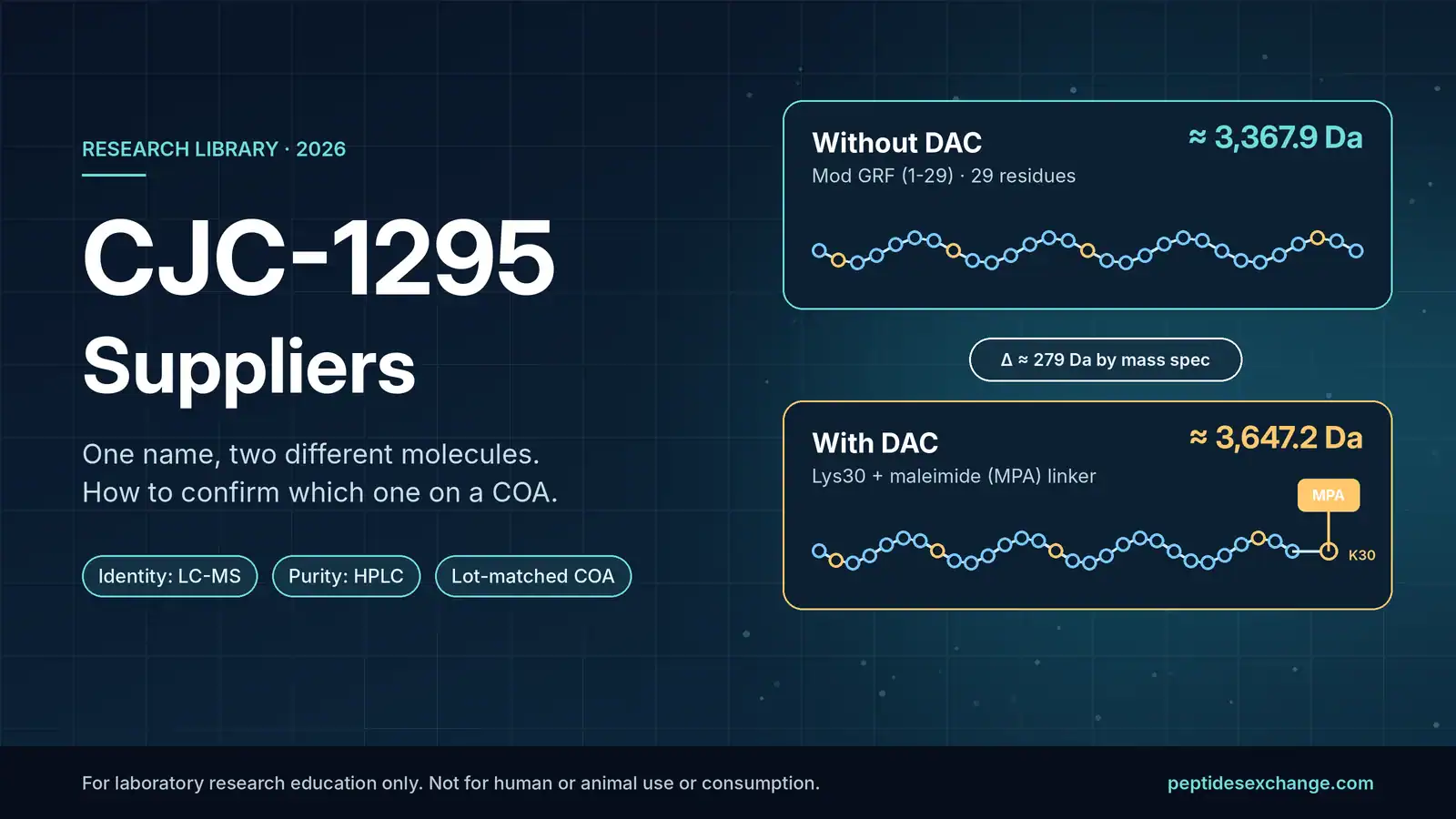
- CJC-1295 with DAC. This is the molecule the name originally described in the scientific literature. It is a modified 29-residue growth hormone–releasing hormone (GHRH) analog with an added lysine and a maleimide-based “drug affinity complex” (DAC) linker built to bind serum albumin (Jetté et al., 2005).
- CJC-1295 without DAC. This is the same modified 29-residue peptide with no lysine extension and no linker. In the research literature and on many certificates it goes by Modified GRF (1-29) or Mod GRF 1-29. “CJC-1295 without DAC” is largely a market name.
They are not two strengths or two grades of one product. They have different molecular formulas, different expected masses, and very different reported pharmacokinetic behavior in the published studies. A supplier page that says only “CJC-1295” leaves the most basic question open: which molecule is in the vial?
This matters for researchers because an experiment designed around one compound produces meaningless results with the other. It matters for compliance because identity is the first thing any honest certificate of analysis must establish. If you are new to these documents, start with our guides on what research peptides are and how to read a peptide COA.
For background on the blend format many vendors sell, see What Is CJC-1295 + Ipamorelin?. For related GHRH analogs, see Sermorelin and Tesamorelin.
The two molecules side by side
Both compounds start from the first 29 amino acids of human GHRH, which is the shortest fragment that keeps full receptor activity. Both carry the same four substitutions, which were chosen to resist enzymatic breakdown (D-Ala at position 2 blocks the DPP-IV cleavage site between residues 2 and 3) and to reduce oxidation and rearrangement elsewhere in the chain (Jetté et al., 2005). The difference is what happens at the C-terminus.
| CJC-1295 without DAC (Mod GRF 1-29) | CJC-1295 with DAC | |
|---|---|---|
| Backbone | GHRH(1-29) with D-Ala2, Gln8, Ala15, Leu27 | Same 29-residue backbone |
| C-terminal addition | None (amidated Arg29) | Extra Lys30 with a maleimidopropionyl (MPA) linker on its side chain |
| Sequence | Y-(D-A)-DAIFTQSYRKVLAQLSARKLLQDILSR-NH2 | Y-(D-A)-DAIFTQSYRKVLAQLSARKLLQDILSRK(MPA)-NH2 |
| Molecular formula | C152H252N44O42 | C165H269N47O46 |
| Average molecular weight | ≈ 3,367.9 g/mol | ≈ 3,647.2 g/mol |
| Mass difference | — | ≈ +279 Da (Lys + MPA linker) |
| Design intent | Short-lived GHRH analog with improved stability | Binds covalently to serum albumin after administration, extending circulation |
| Published human PK | No dedicated published study comparable to the DAC trials | Reported half-life of about 5.8 to 8.1 days (Teichman et al., 2006) |
| Common label names | CJC-1295 no DAC, Mod GRF 1-29, modified GRF, tetrasubstituted GRF(1-29) | CJC-1295, CJC-1295 DAC |
Sequence and formula values are compiled from the primary literature and public chemical databases (PubChem; Wikipedia summary with references). Masses are average (not monoisotopic) values and are rounded. Always compare against the expected mass the supplier’s own COA states.
Why a 279 Da gap is the whole story
On paper the two compounds look nearly identical, and on an HPLC trace they may elute close together. HPLC tells you how pure a sample is, but not what it is. The roughly 279 Da difference between the two molecules is large and easy to see by mass spectrometry, so a properly run identity test separates them without ambiguity. That is why the rest of this guide focuses on the mass result, not the purity number. For a fuller explanation of the two methods, read HPLC vs. LC-MS: Understanding Peptide Purity and Identity Testing.
A note on the maleimide group
The DAC linker was designed to be reactive: its maleimide group bonds to a free thiol on albumin. That same reactivity means a DAC sample can pick up related species during manufacture or storage. One example is maleimide ring hydrolysis, which would appear as a peak about 18 Da heavier than the parent. A good COA for the DAC compound reports the main mass, and the lab should be able to explain any significant secondary peaks.
Where the name came from: the published research
The confusion makes more sense once you see how the literature developed. The “CJC” prefix comes from ConjuChem, the Canadian company that built the albumin-binding DAC platform in the early 2000s. In its papers, the name CJC-1295 refers to the DAC-conjugated compound. The unconjugated tetrasubstituted GRF(1-29) was the starting peptide, not a separate “CJC-1295.”
Preclinical identification (2005)
Jetté L, et al. Endocrinology. 2005;146(7):3052–3058 described a series of hGRF(1-29)–albumin bioconjugates in rats and identified CJC-1295 as the long-acting candidate. The key design finding was that the reactive linker let the peptide bind to circulating albumin, which greatly lengthened its exposure compared with the unmodified peptide.
Human pharmacokinetic studies (2006)
- Teichman SL, et al. J Clin Endocrinol Metab. 2006;91(3):799–805. This was a randomized, placebo-controlled, double-blind study in healthy adults. The authors reported an estimated half-life of about 5.8 to 8.1 days, with growth hormone and IGF-I concentrations staying elevated for days after a single administration. (Open-access PDF via Zenodo.)
- Ionescu M, Frohman LA. J Clin Endocrinol Metab. 2006;91(12):4792–4797. This study examined the pattern of GH secretion and reported that pulsatile release persisted during continuous stimulation by the long-acting analog, while baseline (trough) levels rose.
Both human studies used CJC-1295 with DAC. Their findings, especially the multi-day half-life, are often quoted on product pages for the no-DAC compound, which is a different molecule and was not tested in those trials.
Animal models
Alba M, et al. Am J Physiol Endocrinol Metab. 2006 (PubMed search) studied CJC-1295 in GHRH-knockout mice and examined how the long-acting analog affected growth parameters in that model.
What the literature does not contain
- No FDA-approved product contains either molecule. Clinical development of CJC-1295 did not lead to an approved drug.
- Published human pharmacokinetic data for Mod GRF (1-29) as a standalone research compound are sparse. Statements about its half-life on vendor pages are usually extrapolated, not measured.
- Neither compound has published safety data that would support any use outside a controlled laboratory setting.
This article summarizes published findings for research context only. It is not guidance on any use in people or animals.
How to tell which molecule a supplier sold you
A certificate of analysis can answer three separate questions. Suppliers often blur them together:
- Identity: Is this the molecule on the label? This is answered by mass spectrometry (MS or LC-MS).
- Purity: What share of the peptide material is the target peptide? This is answered by reverse-phase HPLC.
- Content: How much actual peptide is in the vial, compared with counter-ions, water, and salts? This is answered by net peptide content or quantitative analysis.
A 99% HPLC purity result says nothing about which CJC-1295 you have. Only the identity result does.
The COA checklist for CJC-1295
- The molecule is named precisely on the certificate itself. Look for “with DAC” or “without DAC / Mod GRF 1-29” on the COA, not only on the product page.
- An expected mass or formula is stated. It should be about 3,367.9 Da for no-DAC or about 3,647.2 Da for DAC (average mass). Monoisotopic values run about 2 Da lower.
- A measured mass is reported next to the expected mass, with the observed ions or a deconvoluted value.
- The batch or lot number on the COA matches the vial. A generic “representative” COA does not verify your vial.
- The testing lab is identified, with a date and some way to authenticate the report. Many independent labs offer report lookup by ID.
- HPLC purity is shown with a chromatogram, not just a number.
- For blends (for example, CJC-1295 no DAC + Ipamorelin), each component is identified separately.
What the mass spectrum should look like
Peptides this size usually appear in electrospray MS as several multiply charged ions rather than a single peak. Approximate values (average mass) for the protonated forms are:
| Charge state | No DAC (≈ 3,367.9 Da) | With DAC (≈ 3,647.2 Da) |
|---|---|---|
| [M+3H]³⁺ | ≈ 1,123.6 m/z | ≈ 1,216.7 m/z |
| [M+4H]⁴⁺ | ≈ 843.0 m/z | ≈ 912.8 m/z |
| [M+5H]⁵⁺ | ≈ 674.6 m/z | ≈ 730.4 m/z |
These are illustrative calculations. Instrument calibration, adducts (sodium, potassium), and whether the lab reports monoisotopic or average mass will move the exact figures. The point is that the two molecules sit far apart at every charge state. A COA for “CJC-1295 with DAC” showing a deconvoluted mass near 3,368 Da is a mismatch, and so is the reverse.
Red flags
- The COA says only “CJC-1295” with no DAC status and no expected mass.
- Only an HPLC purity figure appears, with no identity test at all.
- The same COA image is reused across many lots or years.
- The product page quotes the multi-day half-life from the 2006 DAC studies for a no-DAC product.
- The lab name, report ID, or date cannot be checked.
Even a perfect COA does not make a research chemical safe or suitable for any use in people. It only documents what was in a tested sample. Peptides Exchange publishes its lot certificates on our Certificates of Analysis page [CONFIRM: that the current CJC-1295 no-DAC/Ipamorelin COA states DAC status and expected mass for each component]. For a broader checklist that covers third-party testing and GMP claims, see Best Peptide Blend Suppliers in 2026: How to Verify Third-Party Testing, COAs, and GMP Claims.
Regulatory status in 2026
Not an approved drug. Neither CJC-1295 with DAC nor Mod GRF (1-29) is approved by the U.S. Food and Drug Administration for any use. Research material sold under either name is not equivalent to, and is not a substitute for, any FDA-approved medicine.
FDA’s stated safety concerns. FDA’s page on bulk drug substances that may present significant safety risks in compounding (content current as of April 22, 2026) lists CJC-1295 among substances whose 503A nomination was withdrawn. It still states that FDA has identified serious adverse events associated with CJC-1295, “including increased heart rate and systemic vasodilatory reaction,” that available clinical data are limited, and that compounded products may pose a risk of immunogenicity for certain routes of administration.
Not part of the April 2026 Category 2 changes. On April 15, 2026, FDA announced it would remove 12 peptides (including BPC-157, TB-500, and MOTS-c) from its Category 2 list ahead of Pharmacy Compounding Advisory Committee review (Frier Levitt summary; JD Supra / National Law Review analysis). CJC-1295 was not on that list. Even for the listed peptides, removal from Category 2 is not approval and does not by itself make a substance eligible for compounding under section 503A. CJC-1295 does not appear on FDA’s 503A bulks list.
“Research use only” is not a loophole. FDA judges a product by how it is marketed, not only by its label. In warning letters to research-peptide sellers such as Summit Research Peptides (Dec. 10, 2024), FDA cited websites whose content showed products were intended for human use despite RUO disclaimers. Dosing language, “benefits” claims, before-and-after testimonials, or bundled injection supplies can turn a research chemical into an unapproved drug in the eyes of regulators.
Supplier comparisons and reviews. The FTC’s Rule on the Use of Consumer Reviews and Testimonials (16 CFR Part 465) prohibits fake or misattributed reviews and company-controlled “independent” review sites. That is one reason this article teaches a verification method instead of publishing a supplier ranking.
Sport. The World Anti-Doping Agency’s Prohibited List bans growth hormone–releasing hormone and its analogues, naming CJC-1295 under class S2 (Peptide Hormones, Growth Factors, Related Substances and Mimetics), at all times.
State law and import rules vary. Some states regulate research chemicals or peptide sales separately, and customs authorities may detain unapproved drug imports. Researchers and institutions are responsible for confirming the rules that apply to them.
This section is general information, not legal advice. Regulations in this area changed several times in 2025 and 2026. Check FDA’s current pages before relying on any status described here.
Frequently asked questions
Are CJC-1295 with DAC and CJC-1295 without DAC the same peptide?
No. They share a 29-amino-acid modified GHRH backbone, but the DAC version adds a lysine and a maleimide-based linker. That gives it a different formula and a mass about 279 Da higher (≈ 3,647.2 vs. ≈ 3,367.9 g/mol, average mass).
What is Mod GRF 1-29?
It is the name used in the literature for tetrasubstituted GRF(1-29), the same compound most suppliers sell as “CJC-1295 without DAC.”
Can HPLC tell DAC and no-DAC apart?
Not reliably on its own. HPLC measures purity. Identity is confirmed by mass spectrometry, which separates the two molecules by their expected masses.
Does the 6-to-8-day half-life apply to CJC-1295 without DAC?
No. That figure comes from human studies of the DAC compound (Teichman et al., 2006). Applying it to the no-DAC molecule is a common labeling error.
Is CJC-1295 FDA approved?
No. Neither form is approved for any use, and FDA has published safety concerns about CJC-1295 in the compounding context.
Which CJC-1295 supplier is best?
We do not rank suppliers, and you should be skeptical of any “top 10” list published by a company that sells the product. The useful question is whether a supplier’s lot-specific COA names the exact molecule, states the expected mass, and reports a matching measured mass from an identifiable lab.
Related articles
- What Is CJC-1295 + Ipamorelin?
- What Is Sermorelin?
- What Is Tesamorelin?
- HPLC vs. LC-MS: Understanding Peptide Purity and Identity Testing
- Peptide Certificate of Analysis: How to Read a COA
- Best Peptide Blend Suppliers in 2026: How to Verify Third-Party Testing, COAs, and GMP Claims
- What Are Research Peptides?
- What Are Peptides?
References
- Jetté L, Léger R, Thibaudeau K, et al. hGRF1-29-albumin bioconjugates activate the GRF receptor on the anterior pituitary in rats: identification of CJC-1295 as a long-lasting GRF analog. Endocrinology. 2005;146(7):3052–3058. PubMed 15817669
- Teichman SL, Neale A, Lawrence B, et al. Prolonged stimulation of growth hormone (GH) and insulin-like growth factor I secretion by CJC-1295, a long-acting analog of GH-releasing hormone, in healthy adults. J Clin Endocrinol Metab. 2006;91(3):799–805. PubMed 16352683 · Zenodo PDF
- Ionescu M, Frohman LA. Pulsatile secretion of growth hormone (GH) persists during continuous stimulation by CJC-1295, a long-acting GH-releasing hormone analog. J Clin Endocrinol Metab. 2006;91(12):4792–4797. PubMed 17018654
- Alba M, et al. Once-daily administration of CJC-1295, a long-acting growth hormone-releasing hormone (GHRH) analog, normalizes growth in the GHRH knockout mouse. Am J Physiol Endocrinol Metab. 2006. PubMed search
- U.S. FDA. Certain Bulk Drug Substances for Use in Compounding that May Present Significant Safety Risks. fda.gov
- U.S. FDA. Bulk Drug Substances Nominated for Use in Compounding Under Section 503A. fda.gov · 503A categories PDF
- U.S. FDA. Warning Letter: Summit Research Peptides, MARCS-CMS 695607, December 10, 2024. fda.gov
- Frier Levitt. FDA to Remove 12 Popular Peptides from the Category 2 “Do Not Compound” List (2026). frierlevitt.com
- National Law Review. Tiny Chains, Big Changes? What FDA’s Latest Actions Mean for Peptide Compounding (2026). natlawreview.com
- World Anti-Doping Agency. The Prohibited List (S2). wada-ama.org
- Federal Trade Commission. Trade Regulation Rule on the Use of Consumer Reviews and Testimonials, 16 CFR Part 465. ftc.gov
- PubChem compound records for CJC-1295. pubchem.ncbi.nlm.nih.gov
Research use disclaimer
All products sold by Peptides Exchange are intended for in-vitro laboratory research use only. They are not drugs, foods, dietary supplements, or cosmetics. They are not intended to diagnose, treat, cure, or prevent any disease and must not be administered to humans or animals. This article is educational and describes published scientific literature. It contains no instructions for use, and nothing in it should be read as medical, legal, or dosing guidance. Statements here have not been evaluated by the FDA. Purchasers must be qualified researchers who agree to handle materials in accordance with all applicable laws.
Leave a Reply