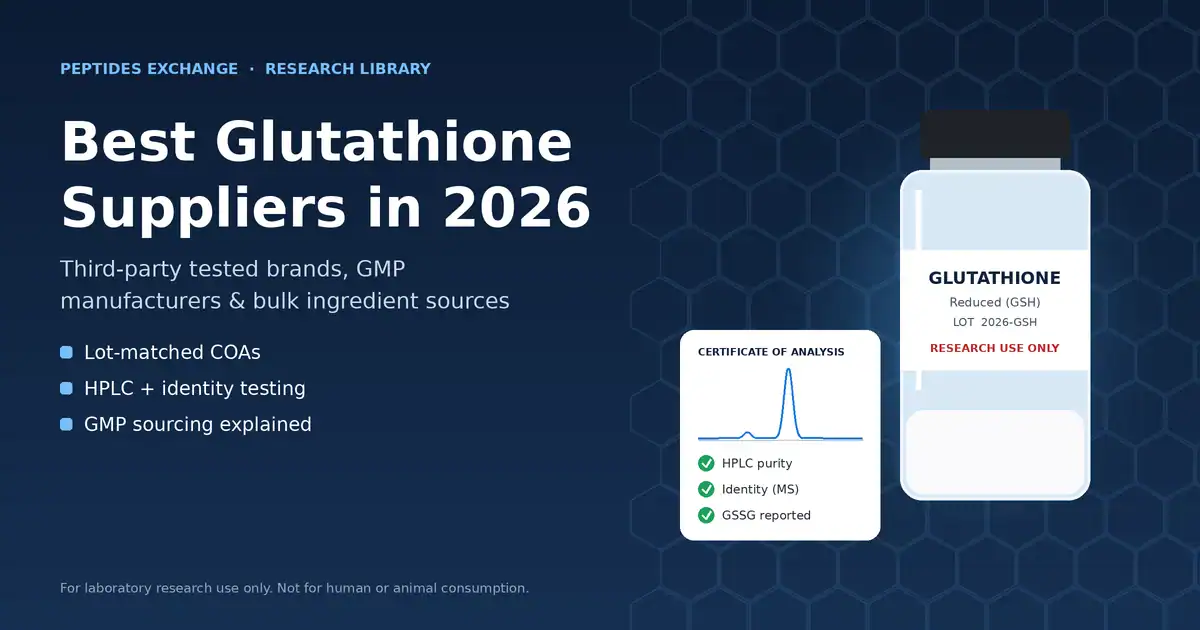
For laboratory and research use only. Not for human or animal consumption, and not a drug, food, cosmetic, or dietary supplement.
The best glutathione suppliers in 2026 are the ones that can prove what is in the vial. That means a batch-specific certificate of analysis (COA), HPLC purity data tied to a lot number, identity confirmation by an independent lab, and a clear account of where the bulk material was made.
“99% pure” on a product page is a marketing line. A lot-matched COA from an accredited lab is evidence. This guide explains how to tell the difference, how the glutathione supply chain works (from fermentation plant to research vial), and which documents a lab should request before material enters a protocol.
This article is written by Peptides Exchange, which sells research compounds; we say so plainly, and we use the same criteria for ourselves that we suggest for everyone else. For more supplier and testing guides, see the Peptides Exchange Research Library.
What Is Glutathione? Identity Basics for Researchers
Glutathione is a tripeptide: γ-L-glutamyl-L-cysteinylglycine. It is built from glutamic acid, cysteine, and glycine, with an unusual gamma-peptide bond between glutamate and cysteine. PubChem lists the molecular formula as C10H17N3O6S, a molecular weight of about 307.3 g/mol, and CAS number 70-18-8.
In cell biology it is studied as a central thiol redox buffer. The reduced form (GSH) and the oxidized disulfide (GSSG) exist as a pair, and their ratio is a common readout in oxidative-stress models (Forman et al., 2009). Its biosynthesis by glutamate-cysteine ligase and glutathione synthetase is reviewed in Lu, 2013.
That redox chemistry is exactly why sourcing matters. GSH oxidizes to GSSG on exposure to air, moisture, and heat, so a poorly handled lot can drift away from its label before it reaches the bench.
Research forms you will see from suppliers
| Form | What it is | What to confirm on the COA |
|---|---|---|
| Reduced L-glutathione (GSH) | The standard crystalline powder, CAS 70-18-8 | HPLC assay, GSSG content, identity (MS or IR) |
| Oxidized glutathione (GSSG) | The disulfide dimer, used as a reference or control | Assay and identity as GSSG, not GSH |
| S-acetyl-L-glutathione | Thiol-protected derivative; a different compound | Correct molecular weight; not sold as “glutathione” |
| Lyophilized research vial | GSH freeze-dried into a sealed vial | Fill weight per vial, lot number, moisture, purity |
Treat each form as a separate material with its own specifications. A COA for reduced GSH does not cover an S-acetyl product, and vice versa. Consumer formats such as capsules, liposomal liquids, and topical products are outside the scope of this guide.
Where Research Glutathione Comes From: Three Supplier Tiers
Most glutathione starts at a small number of bulk manufacturers and passes through one or two hands before it reaches a lab. Commercial GSH is produced mainly by microbial fermentation, typically with yeast, rather than by peptide synthesis (Li, Wei & Chen, 2004). Knowing which tier you are buying from tells you which documents to ask for.
Tier 1: Bulk ingredient manufacturers (GMP producers)
These companies ferment, purify, and crystallize glutathione by the kilogram or ton. The best-known example is Kyowa Hakko Bio, whose Setria® brand of reduced L-glutathione is made by a fermentation process (Kyowa Hakko USA). Kyowa has also announced a self-affirmed GRAS determination for Setria in foods and beverages (Kyowa Hakko USA); that is a food-ingredient status and says nothing about a research vial.
Other API-grade producers, many in Japan, Korea, and China, can be identified through regulatory filings. FDA’s public Drug Master File list and aggregator databases such as PharmaCompass show which manufacturers have filed technical dossiers for glutathione. A filing is not an approval, but it does show the maker has documented its process.
Ask a Tier 1 source for: manufacturer name and site, GMP certificate (and the standard it was audited against), batch COA, residual solvent and heavy metal results, and a specification sheet.
Tier 2: Laboratory reagent and reference-standard suppliers
Chemical catalog companies sell reduced glutathione in gram quantities with published specifications. Examples include MilliporeSigma (reduced L-glutathione, ≥98%), ITW Reagents / PanReac AppliChem (USP-grade reduced L-glutathione), Thermo Fisher Scientific, and TCI. Pharmacopeial reference standards are also available for analytical method work.
These suppliers rarely state the original fermentation source, but their lot COAs and specification sheets are usually detailed and consistent. For an analytical or cell-culture lab, this tier is often the benchmark other suppliers should be measured against.
Tier 3: Research compound vendors (finished vials)
This is where most peptide-focused labs buy: pre-weighed, often lyophilized vials sold for research use only. Peptides Exchange is in this tier. Vendors here repackage bulk material from Tier 1, so the quality of the vial depends on two things: the source powder and the vendor’s own handling, filling, and testing.
Because Tier 3 adds handling steps, it also adds the most variability. That is why lot-matched, third-party COAs matter most at this level.
| Tier | Typical quantity | Main strength | Main risk | Key document |
|---|---|---|---|---|
| 1. Bulk GMP manufacturer | kg to ton | Process control, GMP audits | Minimum orders; most do not sell to small labs | GMP certificate + batch COA |
| 2. Reagent / reference supplier | mg to 100 g | Consistent specs, established QC | Source of powder rarely disclosed | Lot COA + spec sheet |
| 3. Research vial vendor | mg per vial | Convenient, pre-measured | Repackaging, oxidation, mislabeling | Lot-matched third-party COA |
How to Choose the Best Glutathione Suppliers: GMP, Third-Party Testing, and the COA
What “GMP” actually means
“GMP” is not one certificate. For active pharmaceutical ingredients, the international standard is ICH Q7. For finished drugs in the U.S. it is 21 CFR Part 211; for dietary supplements, 21 CFR Part 111. A supplier that says “GMP” should be able to name which standard, which facility, and who audited it.
Two cautions. First, a GMP claim usually describes the upstream powder maker, not the vendor who filled your vial. Second, GMP describes how a product is made; it does not replace testing of the specific lot you receive.
What third-party testing should look like
Independent means the lab has no ownership tie to the seller. Look for labs accredited to ISO/IEC 17025, the general standard for testing-lab competence, and check that the accreditation scope covers the methods used.
Glutathione is harder to test than it looks. GSH can oxidize to GSSG during sample prep, which skews results if the method is not controlled (Giustarini et al., 2016). A credible COA will report GSSG separately rather than folding it into “total glutathione.”
Glutathione COA checklist
- Product name and form (reduced GSH, GSSG, or S-acetyl) match the label
- Lot or batch number matches the number printed on your vial
- Testing lab name, address, and accreditation are shown
- Test date is recent relative to the lot
- HPLC chromatogram is included, not just a percentage
- Purity (assay) by HPLC, with method or column noted
- Identity confirmation by mass spectrometry (expected [M+H]+ near 308.1) or IR
- Oxidized glutathione (GSSG) reported as a separate impurity
- Fill weight or net content per vial for lyophilized products
- Moisture (water content), where relevant to powder stability
- Endotoxin and heavy metals, if your protocol requires them
- The COA can be verified with the lab directly (QR code, report ID, or lookup page)
New to reading these documents? Our guide on how to read a peptide COA walks through a chromatogram line by line.
Red flags when comparing glutathione suppliers
- One COA for every lot. A single, undated certificate reused across batches is not lot data.
- In-house testing only. Fine as a supplement to third-party data, not a replacement.
- Purity with no identity test. HPLC purity tells you the main peak is clean, not that the main peak is glutathione.
- No GSSG figure. For a compound defined by its redox state, this is a key omission.
- Human-use language. Dosing charts, “benefits,” skin or wellness claims, or reconstitution calculators beside a “research only” label. FDA treats these as evidence of intended human use (see the compliance section below).
- No sourcing information at all. A seller does not need to name its manufacturer publicly, but it should be able to tell a qualified buyer the country of origin and manufacturing standard.
Comparing Glutathione Supplier Types in 2026
Rather than rank individual competitors on figures we cannot independently verify, the table below compares what each type of supplier typically provides. Use it as a scorecard: any supplier you are considering should be able to fill in every column for the specific lot you are buying.
| What to check | Bulk GMP manufacturer | Reagent / reference supplier | Research vial vendor (well documented) | Research vial vendor (poorly documented) |
|---|---|---|---|---|
| Lot-specific COA | Yes | Yes | Yes, lot matched to vial | Generic or reused |
| HPLC chromatogram shown | On request | Often | Yes | Percentage only |
| Identity test (MS/IR) | Yes | Yes | Yes | Rarely |
| GSSG reported separately | Usually | Usually | Should be | No |
| Independent (third-party) lab | Internal QC + audits | Internal QC | Yes, named lab | Unnamed or in-house |
| Manufacturing standard named | Yes (e.g., ICH Q7) | Grade stated (e.g., USP) | Source standard stated | “GMP” with no detail |
| Research-use-only labeling | Not applicable | Yes | Yes | Inconsistent; human-use language |
| Small-quantity orders | No | Yes | Yes | Yes |
How Peptides Exchange documents glutathione
We hold our own listings to the same scorecard. For each glutathione lot, the product page and COA should show:
- Lot number: [LOT # printed on vial]
- HPLC purity: [XX.XX%] with chromatogram attached
- Identity: [MS result, observed m/z]
- GSSG: [X.X%]
- Testing lab: [Lab name, accreditation]
- Test date: [MM/DD/YYYY]
- Source material standard: [e.g., manufactured under ICH Q7 GMP, country of origin]
- Vial content: [mg per vial], lyophilized, sealed under [nitrogen/vacuum if applicable]
If any field above is blank for the lot you received, contact us before using the material. You can browse our other supplier and testing guides in the Research Library, including our articles on NAD+ and research peptide documentation.
Research Use Only: What the Label Means Legally
A “research use only” (RUO) label is a statement of intended use, and U.S. law looks at the whole picture, not just the label. Under the Federal Food, Drug, and Cosmetic Act, a product intended for use in the diagnosis, cure, mitigation, treatment, or prevention of disease, or to affect the structure or function of the body, is a drug (21 U.S.C. § 321(g)(1)). FDA determines intended use from labeling, advertising, and the circumstances of sale (21 CFR 201.128).
FDA has acted on this repeatedly. In August 2026, CDER sent warning letters to five online peptide sellers, rejecting their RUO disclaimers because their websites, read as a whole, pointed to human use. The cited practices included dosing guidance, disease or body-function claims, reconstitution calculators, and selling bacteriostatic water alongside injectable products (Arent Fox Schiff analysis). Earlier enforcement followed the same reasoning (for example, FDA’s December 2024 warning letter to Summit Research Peptides).
Glutathione’s separate regulatory tracks
Glutathione is unusual because it sits in several regulatory categories at once, none of which applies to a research vial:
- Food and supplement ingredient. Reduced glutathione is sold as a dietary-supplement ingredient, and at least one manufacturer has announced a self-affirmed GRAS position for food use (Kyowa Hakko USA). Supplements must be made under 21 CFR Part 111 and labeled as supplements. RUO material is neither.
- Compounding. In 2022, FDA’s Pharmacy Compounding Advisory Committee voted 8–5 to recommend glutathione for the 503A bulk drug substances list. The vote was not binding, and FDA staff had recommended against it (Alliance for Pharmacy Compounding; Reed Smith). Compounding is limited to licensed pharmacies acting on prescriptions; a research vendor is not one.
- Laboratory reagent. This is the only category a research vial belongs to: material for in vitro and other laboratory investigations by qualified researchers.
Our compliance standards for this product
- Sold strictly for in vitro laboratory research by qualified buyers aged 21 or older
- No dosing, administration, or reconstitution guidance for human or animal use
- No therapeutic, cosmetic, wellness, or structure/function claims
- No testimonials or before-and-after content
- Not sold or bundled with syringes or diluents intended for injection
The FTC also requires that any health-related claim be backed by competent and reliable scientific evidence (FTC Health Products Compliance Guidance). Nothing in this article is such a claim, and nothing here is medical or legal advice.
Storage and Stability of Research Glutathione
GSH’s free thiol makes it prone to oxidation, so handling after delivery matters as much as purity at release. Keep vials sealed, dry, protected from light, and at the temperature on the supplier’s lot documentation. Check for clumping, discoloration, or a broken seal on arrival, and record the lot number in your lab notebook so results can be traced to a specific COA.
Frequently Asked Questions
Who are the best glutathione suppliers in 2026?
The best suppliers are those that publish lot-matched, third-party COAs with an HPLC chromatogram, identity testing, a separate GSSG result, and a named manufacturing standard. That can include bulk GMP manufacturers, reagent suppliers, and well-documented research vendors.
Is glutathione a peptide?
Yes. It is a tripeptide of glutamic acid, cysteine, and glycine, joined in part by a gamma-peptide bond (PubChem).
What should a glutathione COA include?
Lot number, testing lab and accreditation, test date, HPLC purity with chromatogram, identity by MS or IR, GSSG content, and fill weight for vials.
What purity should research-grade glutathione show?
Catalog reagent grades are commonly specified at ≥98% (MilliporeSigma). The right threshold depends on your protocol; what matters most is that the figure comes from a lot-specific, verifiable test.
What is the difference between reduced and S-acetyl glutathione?
Reduced glutathione (GSH) has a free thiol. S-acetyl glutathione has an acetyl group on the sulfur, making it a different compound with a different molecular weight. Each needs its own COA.
How is bulk glutathione made?
Mostly by microbial fermentation, followed by purification and crystallization (Li, Wei & Chen, 2004).
Does “GMP” mean a glutathione vial is tested?
No. GMP describes how material is manufactured, usually upstream. Each finished lot still needs its own testing.
Can research glutathione be used in people or animals?
No. Research-use-only material is not a drug, supplement, or cosmetic, and is not intended for human or animal use of any kind.
Summary
To find the best glutathione suppliers, ignore the adjectives and check four things for the specific lot: a third-party COA matched to the vial, HPLC purity with identity confirmation and a GSSG result, a named manufacturing source and standard, and consistent research-use-only labeling with no human-use claims. A supplier that cannot provide all four is not ready for your lab.
Related reading: Research Library · How to read a peptide COA · NAD+ research overview
All products sold by Peptides Exchange are for laboratory research use only. Not for human or animal consumption. These statements have not been evaluated by the Food and Drug Administration. Products are not intended to diagnose, treat, cure, or prevent any disease. Buyers must be 21 or older.
References
- National Center for Biotechnology Information. Glutathione, PubChem Compound Summary (CID 124886).
- Forman HJ, Zhang H, Rinna A. Glutathione: overview of its protective roles, measurement, and biosynthesis. Mol Aspects Med. 2009;30(1-2):1-12.
- Lu SC. Glutathione synthesis. Biochim Biophys Acta. 2013;1830(5):3143-3153.
- Li Y, Wei G, Chen J. Glutathione: a review on biotechnological production. Appl Microbiol Biotechnol. 2004;66(3):233-242.
- Giustarini D, et al. Pitfalls in the analysis of the physiological antioxidant glutathione (GSH) and its disulfide (GSSG) in biological samples. J Chromatogr B. 2016;1019:21-28.
- U.S. FDA. Q7 Good Manufacturing Practice Guidance for Active Pharmaceutical Ingredients.
- eCFR. 21 CFR Part 211, cGMP for Finished Pharmaceuticals.
- eCFR. 21 CFR Part 111, cGMP for Dietary Supplements.
- eCFR. 21 CFR 201.128, Meaning of “intended uses”.
- Legal Information Institute. 21 U.S.C. § 321, Definitions.
- ISO. ISO/IEC 17025: Testing and calibration laboratories.
- U.S. FDA. List of Drug Master Files.
- U.S. FDA. Warning Letter: Summit Research Peptides (Dec. 10, 2024).
- Arent Fox Schiff. RUO-ined: Five Peptide Vendors Learn That “Research Use Only” Is Not a Legal Strategy.
- Alliance for Pharmacy Compounding. PCAC Recommends Glutathione for Bulks List.
- Reed Smith. PCAC Votes on Substances Nominated for Inclusion.
- Kyowa Hakko USA. Setria® Glutathione Expands Reach; GRAS Self-Affirmation for Setria®.
- MilliporeSigma. L-Glutathione reduced, product G4251.
- ITW Reagents. L-Glutathione reduced (USP, pure, pharma grade).
- U.S. FTC. Health Products Compliance Guidance.
Leave a Reply