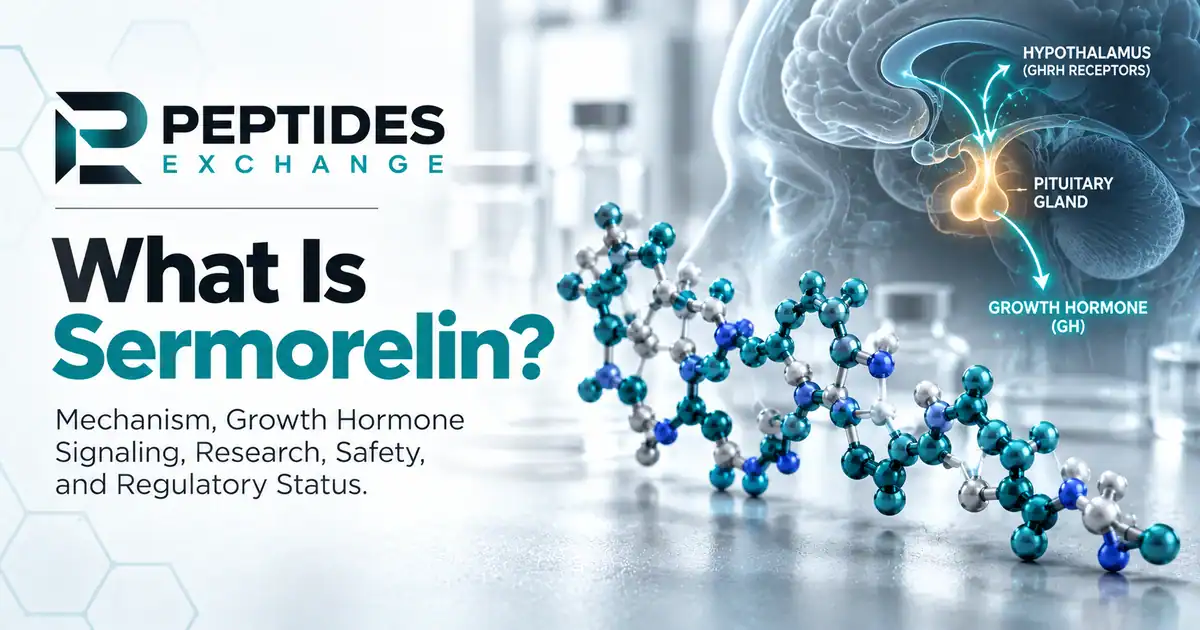
Sermorelin is a synthetic 29-amino-acid peptide derived from human growth hormone-releasing hormone, or GHRH. Rather than functioning as growth hormone itself, sermorelin acts upstream in the growth-hormone signaling pathway by stimulating receptors on the pituitary gland that can trigger the release of the body’s own growth hormone.
This distinction is fundamental to understanding sermorelin.
Growth hormone, or GH, is the downstream hormone. Sermorelin is a GHRH analogue that stimulates the biological pathway responsible for releasing GH.
Sermorelin has an unusually long history compared with many peptides now discussed in research circles. A prescription product containing sermorelin acetate, Geref, was previously approved by the U.S. Food and Drug Administration. Those products were later discontinued from the U.S. market, although the FDA subsequently determined that they were not withdrawn because of safety or effectiveness concerns.
Understanding that history helps separate established sermorelin research from the much broader claims now made about the peptide online.
For more background on the category itself, see What Are Research Peptides?.
What Kind of Peptide Is Sermorelin?
Sermorelin is the synthetic form of growth hormone-releasing factor 1-29 amide, often abbreviated GHRH(1-29)-NH₂.
Naturally occurring human GHRH contains 44 amino acids. Researchers discovered that much of its biological activity is concentrated within the first 29 amino acids.
Sermorelin therefore corresponds to the biologically active N-terminal portion of human GHRH.
A scientific review describes sermorelin as the shortest synthetic peptide retaining the full biological activity of GHRH.
This differentiates it from several other peptides associated with the GH/IGF-1 axis.
| Compound | General Classification | Primary Signaling Target |
|---|---|---|
| Sermorelin | GHRH analogue | GHRH receptor |
| Tesamorelin | Modified GHRH analogue | GHRH receptor |
| CJC-1295 | Synthetic GHRH analogue | GHRH receptor |
| Ipamorelin | Growth hormone secretagogue | Ghrelin/GHS receptor |
| Growth hormone | Pituitary hormone | GH receptor |
These compounds may converge on aspects of growth-hormone signaling, but they do so through different molecular mechanisms.
How Does Sermorelin Work?
The growth-hormone axis begins in the hypothalamus.
The hypothalamus normally releases GHRH, which travels to the anterior pituitary and activates GHRH receptors on somatotroph cells.
This signaling stimulates secretion of growth hormone.
Sermorelin reproduces part of that GHRH signal.
In simplified form:
Sermorelin → GHRH receptor → pituitary GH release → downstream GH signaling → IGF-1 production
Growth hormone subsequently influences multiple tissues and stimulates production of insulin-like growth factor 1, or IGF-1, particularly in the liver.
That does not mean sermorelin and growth hormone are interchangeable.
Sermorelin depends on a functioning pituitary capable of responding to GHRH stimulation. Administered recombinant growth hormone bypasses that step by supplying GH directly.
Human experiments demonstrated decades ago that GHRH(1-29) could produce substantial increases in circulating GH while showing relatively specific activity on the growth-hormone axis.
Sermorelin Stimulates Endogenous Growth Hormone
One reason researchers have remained interested in sermorelin is that it stimulates endogenous, or internally produced, GH.
That is conceptually different from administering recombinant human growth hormone.
Sermorelin’s response is influenced by factors including:
- Pituitary function
- Hypothalamic function
- Age
- Baseline endocrine status
- Individual responsiveness of pituitary somatotroph cells
A person or experimental subject with inadequate pituitary reserve may therefore respond differently than someone with an intact pituitary.
This limitation was recognized in the historical diagnostic literature. A normal response to sermorelin could not necessarily rule out a hypothalamic cause of growth-hormone deficiency, while an impaired pituitary response could limit the effect of GHRH stimulation.
How Long Does Sermorelin Last?
Sermorelin’s relatively short plasma half-life is one of its defining biochemical characteristics.
Published pharmacology research has estimated its plasma half-life at approximately 10 to 20 minutes.
Its short persistence results partly from enzymatic degradation at its N-terminal region and renal clearance.
Importantly, a short plasma half-life does not mean its biological effect disappears at exactly the same moment that the peptide leaves circulation.
Receptor activation initiates a downstream biological response, including pituitary GH release.
The short half-life nevertheless became one reason researchers pursued longer-lasting GHRH analogues and modified formulations.
Sermorelin vs Tesamorelin
Sermorelin and tesamorelin belong to the same general signaling family but are not the same peptide.
Both act through the GHRH receptor.
Sermorelin consists of the active 1-29 amino-acid sequence derived from human GHRH.
Tesamorelin is a modified GHRH analogue designed to resist enzymatic degradation more effectively.
Their regulatory histories also differ substantially.
Sermorelin-containing Geref products are discontinued in the United States. Tesamorelin remains available as an FDA-approved prescription medication under products including Egrifta SV for reduction of excess abdominal fat in certain adults with HIV-associated lipodystrophy.
This is a useful example of why two peptides targeting the same receptor cannot automatically be treated as clinically interchangeable.
What Did Early Sermorelin Research Find?
Much of the strongest direct human evidence for sermorelin comes from older studies investigating growth-hormone deficiency.
One multicenter study evaluated 110 previously untreated prepubertal children with GH deficiency.
Among the children included in the efficacy analysis, average height velocity increased from approximately 4.1 centimeters per year before treatment to 7.2 centimeters per year after 12 months.
Researchers reported that the treatment was generally well tolerated.
These results established biological activity but should not be extrapolated indiscriminately.
A pediatric GH-deficiency study does not establish that sermorelin produces equivalent effects in healthy adults, athletes, older adults, or people seeking changes in body composition.
How Did Sermorelin Compare With Growth Hormone?
Historical research also highlighted an important limitation.
Some studies found that direct recombinant growth hormone could produce greater growth responses than GHRH-based treatment in children with GH deficiency.
One early comparison found substantially better growth after participants were switched from GHRH treatment to recombinant human GH. The researchers concluded at the time that GHRH could not be recommended as routine therapy for childhood GH deficiency based on those data.
Later trials showed that some children did respond well to once-daily GHRH(1-29), illustrating that response depended on the underlying endocrine defect and study population.
This is another reason simple claims that sermorelin is categorically “better than HGH” are not supported by the evidence.
Does Sermorelin Increase IGF-1?
Because growth hormone stimulates IGF-1 production, increasing endogenous GH signaling can potentially affect circulating IGF-1.
Research involving GH secretagogues has reported increases in IGF-1, although modern adult sermorelin evidence is far less extensive than many commercial websites imply.
For example, a retrospective study involving a combination of sermorelin with other growth-hormone secretagogues found increases in IGF-1 among a small selected group of men. However, the study involved multiple compounds simultaneously and included only 14 men meeting the strict analysis criteria, making it impossible to attribute the result specifically to sermorelin alone.
That is a good example of why study design matters.
A combination study cannot establish the effect of one component with the certainty of a randomized sermorelin-only trial.
What About Claims Involving Muscle, Fat Loss, Sleep, or Anti-Aging?
This is where the online discussion of sermorelin often moves far beyond the evidence.
Sermorelin is frequently marketed around claims involving:
- Increased muscle
- Reduced body fat
- Improved recovery
- Better sleep
- Increased energy
- Improved skin
- Anti-aging
- Increased exercise performance
The problem is that modern, high-quality clinical evidence directly demonstrating these outcomes with sermorelin is limited.
A published review discussing growth-hormone secretagogues in men acknowledged potential effects related to the GH/IGF-1 axis while simultaneously emphasizing that clinical evidence remains limited.
A more recent 2026 review of performance-enhancing peptides likewise described major gaps between online peptide use and the available clinical evidence.
It is therefore inaccurate to turn the biological statement:
“Sermorelin can stimulate GH release”
into the much broader conclusion:
“Sermorelin has been proven to build muscle, burn fat, improve sleep, reverse aging, and improve performance.”
Those are separate claims requiring separate evidence.
Was Sermorelin Ever FDA Approved?
Yes.
This is an unusual part of sermorelin’s history.
The FDA approved sermorelin acetate under the trade name Geref. FDA records show historical approval for sermorelin products used in connection with growth-hormone deficiency and diagnostic evaluation.
However, the Geref products were ultimately discontinued.
FDA documentation indicates the product was withdrawn by the applicant, with the withdrawal effective in 2009.
Was Geref Withdrawn Because Sermorelin Was Unsafe?
No—that would misrepresent the FDA record.
In 2013, the FDA specifically reviewed the issue and determined that the discontinued Geref products were not withdrawn from sale for reasons of safety or effectiveness.
The agency therefore continued listing them in the discontinued section of the Orange Book and stated that qualifying abbreviated new-drug applications could potentially be approved if all regulatory requirements were met.
That finding needs to be interpreted carefully.
It means:
FDA did not determine that Geref was withdrawn because it was unsafe or ineffective.
It does not mean:
Every sermorelin product currently sold is FDA approved.
Those are entirely different statements.
Is Sermorelin FDA Approved Today?
The historically approved Geref products are discontinued and are not currently marketed in the United States. FDA’s own reviews have described Geref/sermorelin acetate as withdrawn from the market.
FDA’s substance database still identifies sermorelin acetate and its historical regulatory records, but the agency specifically warns that the presence of a substance in such a database does not itself mean that a current product has undergone regulatory review or approval.
This distinction is particularly important for research products.
A vial sold today as a research material does not acquire Geref’s historical FDA approval simply because both materials are described as containing sermorelin.
FDA has taken enforcement action against peptide vendors that marketed sermorelin and other research compounds with disease-treatment or human-use claims as though they were lawful therapeutic products.
What Side Effects Were Reported in Sermorelin Research?
Historical clinical studies generally described sermorelin as well tolerated.
The 1999 review of pediatric studies reported transient facial flushing and injection-site pain among the more frequently reported adverse events.
Older clinical information has also described reactions such as:
- Injection-site discomfort
- Redness or swelling
- Flushing
- Headache
- Dizziness
- Hypersensitivity reactions
Because the branded U.S. products are discontinued, there is no modern current Geref prescribing information comparable to the active labels maintained for currently marketed drugs.
That means newer websites should be cautious about presenting a tidy modern “official sermorelin side-effect profile” as though it comes from a current FDA label.
Could Altering the GH/IGF-1 Axis Have Broader Effects?
Potentially.
Growth hormone and IGF-1 regulate far more than linear growth.
They participate in:
- Protein metabolism
- Lipid metabolism
- Glucose regulation
- Tissue growth
- Bone metabolism
- Fluid balance
Consequently, manipulating this endocrine axis deserves more scrutiny than simply asking whether a peptide produces a GH spike.
Current FDA labeling for the related GHRH analogue tesamorelin, for example, includes warnings regarding elevated IGF-1, glucose intolerance or diabetes, fluid retention, hypersensitivity reactions, and malignancy-related considerations.
Those warnings belong specifically to tesamorelin and should not be copied directly onto sermorelin as though the two drugs have identical clinical safety profiles.
They do, however, demonstrate why long-term stimulation of the GH/IGF-1 axis requires appropriate scientific evaluation.
Sermorelin vs CJC-1295
Sermorelin and CJC-1295 are often grouped together because both interact with the GHRH pathway.
They are nevertheless different molecules.
Sermorelin is essentially the biologically active GHRH(1-29) fragment.
CJC-1295 was developed with modifications intended to extend activity compared with native GHRH fragments. Certain versions incorporate a drug-affinity complex designed for prolonged association with albumin.
As a result, research involving one compound should not automatically be cited as evidence for the other.
The same principle applies to tesamorelin.
“GHRH analogue” describes a pharmacological family—not a single interchangeable substance.
Sermorelin vs Ipamorelin
Ipamorelin operates through a different receptor system.
Sermorelin stimulates the GHRH receptor.
Ipamorelin is classified as a growth hormone secretagogue acting through the ghrelin/GHS receptor.
Both pathways can influence GH secretion, but the upstream signaling mechanism differs.
This is why combining all “GH peptides” into one category obscures important pharmacological distinctions.
Research Material vs Historical Pharmaceutical Product
Researchers evaluating sermorelin should distinguish among at least three different questions:
1. Is the molecule chemically identified as sermorelin?
2. Does an analytical test establish identity or purity of a specific sample?
3. Has that specific product undergone regulatory review for clinical safety and efficacy?
Those questions are not interchangeable.
An HPLC purity result can provide information about chromatographic purity.
Mass spectrometry can contribute evidence about molecular identity.
A Certificate of Analysis can document specific tests performed on a particular sample.
None of those documents transforms a research material into an FDA-approved pharmaceutical product.
For more information on analytical testing, see HPLC vs. LC-MS: Understanding Peptide Purity and Identity Testing.
You can also read How to Read a Peptide Certificate of Analysis.
Why Is Sermorelin Still Studied?
Despite its age, sermorelin remains scientifically interesting for several reasons.
First, it provides a relatively direct method for studying GHRH-receptor signaling and pituitary GH secretion.
Second, its short half-life makes it useful for studying temporal relationships between receptor stimulation and endocrine response.
Third, comparisons between sermorelin, longer-acting GHRH analogues, growth-hormone secretagogues, and recombinant GH can help researchers distinguish different ways of manipulating the GH/IGF-1 axis.
Finally, sermorelin’s long clinical history means substantially more human information exists for it than for many newer experimental peptides.
That history does not eliminate unanswered questions—particularly regarding many of the uses now promoted outside its historical indications.
Frequently Asked Questions
Is Sermorelin Growth Hormone?
No.
Sermorelin is a GHRH analogue that stimulates the pituitary to release endogenous growth hormone. Growth hormone itself is a different molecule.
Is Sermorelin a Peptide?
Yes.
Sermorelin is a 29-amino-acid peptide corresponding to the biologically active N-terminal portion of human GHRH.
Does Sermorelin Increase Growth Hormone?
Human clinical research demonstrates that GHRH(1-29) can stimulate pituitary GH release. The magnitude of the response depends on biological factors including pituitary function.
Does Sermorelin Increase IGF-1?
Because GH stimulates IGF-1 production, stimulation of the GH axis can influence IGF-1. However, the magnitude of the response varies, and modern sermorelin-only adult clinical evidence is limited.
Is Sermorelin the Same as Tesamorelin?
No.
Both act through the GHRH receptor, but they are structurally different peptides with different pharmacokinetic and regulatory histories.
Is Sermorelin the Same as Ipamorelin?
No.
Sermorelin acts through GHRH receptors, while ipamorelin belongs to the growth-hormone secretagogue family and primarily signals through the ghrelin/GHS receptor.
Is Sermorelin FDA Approved?
Sermorelin-containing Geref was historically FDA approved, but those products were discontinued from the U.S. market. FDA determined that they were not withdrawn because of safety or effectiveness concerns. That historical approval does not make unrelated sermorelin research products FDA-approved drugs.
Is Sermorelin Proven for Anti-Aging?
No.
The biological relationship between aging and the GH/IGF-1 axis has generated research interest, but there is not strong modern clinical evidence establishing sermorelin as an FDA-approved or proven anti-aging treatment.
Final Thoughts
Sermorelin is one of the better-characterized peptides associated with the growth-hormone axis.
Its mechanism is straightforward: it reproduces the active portion of GHRH, stimulates pituitary GHRH receptors, and can trigger endogenous growth-hormone secretion.
Its history, however, is more nuanced than either extreme commonly presented online.
Sermorelin is not merely an obscure experimental peptide with no human history. A sermorelin pharmaceutical product was previously FDA approved and was studied in human populations.
But the opposite claim is also wrong.
Historical Geref approval does not establish modern research products as FDA-approved medicines, and historical evidence for childhood growth-hormone deficiency does not prove the much broader claims now made about muscle growth, fat loss, anti-aging, sleep, recovery, or athletic performance.
The scientifically defensible view sits between those extremes: sermorelin has a well-established GHRH mechanism and meaningful historical clinical evidence, while many of its modern commercial claims extend beyond what controlled research has established.
This article is provided for educational and scientific-information purposes. It does not provide dosing, administration, or treatment recommendations.
Sources and Further Reading
- FDA — Geref orphan-drug approval record. Historical approval of sermorelin acetate for childhood growth-hormone deficiency.
- FDA/Federal Register — Determination regarding withdrawal of Geref. FDA concluded the drug was not withdrawn for reasons of safety or effectiveness.
- Prakash & Goa — Sermorelin review, BioDrugs. Review of pharmacology, diagnostic applications, clinical response, and tolerability.
- Geref International Study Group — pediatric GH-deficiency study. Evaluated growth velocity during one year of GHRH(1-29) research.
- GHRH(1-29) human dose-response research. Demonstrated stimulation of GH release in adult volunteers.
- Esposito et al. — GHRH analogue pharmacology. Describes sermorelin’s approximately 10–20 minute plasma half-life and susceptibility to enzymatic degradation.
- Comparison of GHRH and recombinant GH therapy. Historical comparison illustrating differences between pituitary stimulation and direct GH administration.
- FDA — historical Geref approval package. Regulatory documentation for sermorelin acetate for injection.
- FDA review of adult GH-deficiency diagnostics. Notes that Geref/sermorelin had been withdrawn from the U.S. market and cites the FDA determination regarding safety and efficacy.
- FDA GSRS — Sermorelin acetate. Substance identity, synonyms, historical designation, and regulatory-record information.
- Growth hormone secretagogue research in men. Small retrospective study illustrating IGF-1 effects and limitations of combination-secretagogue evidence.
- Review of growth hormone secretagogues and body composition. Discusses sermorelin and related compounds while highlighting limitations in clinical evidence.
- 2026 review of performance-enhancing peptides affecting the GH/IGF-1 axis. Reviews sermorelin, tesamorelin, CJC-1295, ipamorelin, and related research compounds and emphasizes evidence gaps.
- FDA — current Egrifta SV prescribing information. Useful for understanding the current regulatory and safety framework for the related GHRH analogue tesamorelin.
- FDA warning letter involving sermorelin and other peptide products. Illustrates the regulatory distinction between research materials and products marketed with therapeutic claims.
Leave a Reply