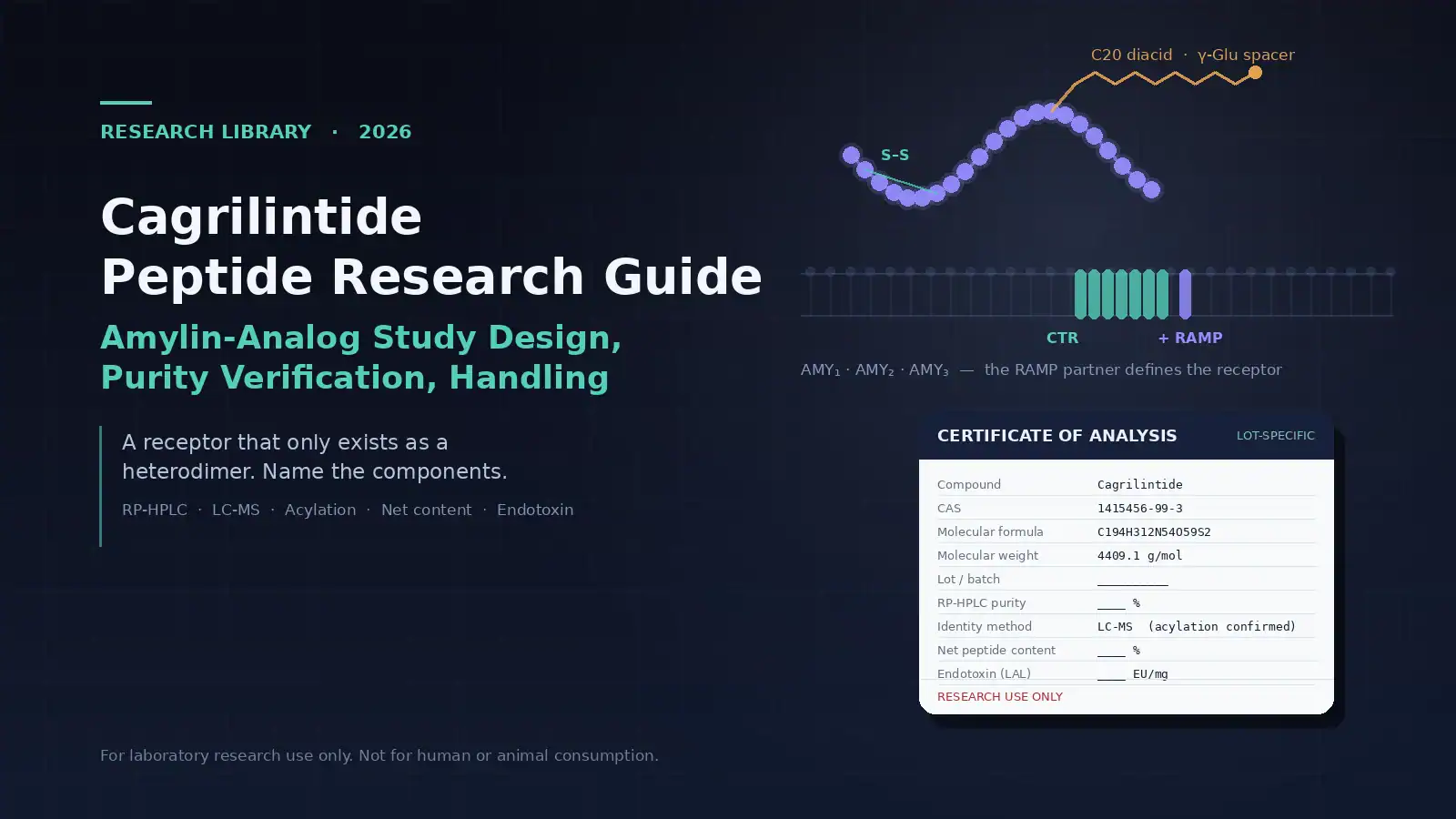

The amylin receptor is not a single protein — it is the calcitonin receptor plus a RAMP, which is why study design has to name both.
Most writing about cagrilintide is about what it might do for people. This guide is not. It is about what makes the compound difficult to work with in a laboratory, and what you need from a supplier before an experiment is worth running. Peptides Exchange sells research peptides, so treat the verification standards below as claims to test against us as readily as against anyone else.
Cagrilintide deserves a methods guide more than most peptides in this market, for three reasons that compound one another. Its receptor is not a single protein. Its molecule carries a lipid chain that routine purity testing can miss. And its parent hormone is one of the most aggregation-prone peptides in human biology.
There is also a regulatory dimension specific to this compound, covered in full below: cagrilintide is an investigational drug with an application currently before FDA, and it was named by FDA in April 2026 warning letters to sellers marketing research-use-only peptides. Anyone building work around this material should read that section before the methods.
New here? Start with What Are Research Peptides? and Peptide Certificate of Analysis: How to Read a COA.
What cagrilintide is, chemically
Cagrilintide is a synthetic, lipidated, long-acting analog of human amylin (islet amyloid polypeptide, IAPP) — a 37-residue pancreatic hormone. It was developed at Novo Nordisk and described in the medicinal chemistry literature by Kruse and colleagues in 2021.
| Property | Value |
|---|---|
| Molecular formula | C₁₉₄H₃₁₂N₅₄O₅₉S₂ |
| Molecular weight | ≈ 4409.1 g/mol (free base) |
| CAS number | 1415456-99-3 |
| PubChem CID | 167312356 |
| UNII | AO43BIF1U8 |
| Parent hormone | Human amylin / IAPP, 37 residues |
| Backbone length | 37 residues, C-terminally amidated |
| Structural features | Intramolecular disulfide bridge (Cys2–Cys7); C20 fatty diacid on a lysine side chain via a γ-glutamyl spacer |
| Development code | AM833 |
| FDA approval status | None — investigational |
Three structural features drive everything that follows.
The disulfide bridge. Amylin and its analogs carry an intramolecular disulfide between Cys2 and Cys7, forming a small N-terminal ring. That ring is required for receptor activation, and it is chemically fragile: reducing conditions break it, and oxidative or alkaline conditions can scramble it into incorrectly paired isomers. A scrambled molecule has the same mass as the correct one, which means mass spectrometry alone cannot detect the problem.
The C-terminal amide. Like the parent hormone, the molecule is amidated at the C-terminus. The free-acid form is a different molecule roughly 1 Da heavier, and a certificate that writes a sequence without the amide has omitted a structural feature.
The lipid chain. A C20 fatty diacid is attached to a lysine side chain through a γ-glutamyl spacer. This is the standard albumin-binding strategy used to extend circulating half-life, and it is the single most important thing to verify analytically — for reasons covered under purity below.
Native human amylin is also among the most amyloidogenic peptides known; IAPP fibril deposition in pancreatic islets is a well-studied pathological process. Analog design in this class exists largely to defeat that aggregation tendency, and it is why pramlintide — the earlier, approved amylin analog — substitutes prolines into the amyloidogenic core.
The receptor is a heterodimer, and that changes study design
This is the part most protocols underspecify, and it is where otherwise careful experiments become uninterpretable.
There is no single “amylin receptor” gene. Amylin receptors are formed when the calcitonin receptor (CTR) heterodimerizes with a receptor activity-modifying protein. Three RAMPs give three receptors:
| Receptor | Composition | Note |
|---|---|---|
| AMY₁ | CTR + RAMP1 | AMY₁(a) responds to CGRP about as well as to amylin |
| AMY₂ | CTR + RAMP2 | Particularly difficult to observe experimentally |
| AMY₃ | CTR + RAMP3 | The most commonly used in pharmacological characterization |
This is structurally unlike the incretin receptors. GLP-1, GIP, and glucagon receptors are single-gene class B GPCRs that require no accessory protein — see GLP-1, GIP, and Glucagon: How Single, Dual, and Triple Receptor Agonists Differ. A protocol that says “transfected the amylin receptor” has not specified an experiment. A protocol that says “CTR(a) + RAMP3, stable line, receptor density measured” has.
Two complications the IUPHAR review flags directly
CTR splice variants. Human CTR exists as two splice variants: CT(a), lacking a 16-residue insert in the first intracellular loop, and CT(b), containing it. The insert impairs Gq coupling while making little difference to Gs coupling — so each AMY receptor has (a) and (b) subtypes, and the variants differ across species. Report which one you used.
Free CTR contaminates the signal. CTR reaches the cell surface without a RAMP. Transfected cells therefore contain a mixture of free CTR and CTR/RAMP complexes, and a cAMP response measured in that system is a blend of both. The review notes that displacement of [¹²⁵I]-amylin is the most reliable measure of true AMY affinity, and that endogenous lines such as MCF-7 express several receptors at once and are not recommended as a model for this family.
Why this matters specifically for cagrilintide
Cagrilintide is not an AMY-selective agonist. Published binding and functional data characterize it as a dual amylin and calcitonin receptor agonist (DACRA) — it engages the unmodified calcitonin receptor with affinity in the same range as AMY₃. Commercial characterization data report human AMY₃ binding IC₅₀ ≈ 170 pM against calcitonin receptor binding IC₅₀ ≈ 223 pM, with reporter-assay EC₅₀ values of ≈ 49 pM and ≈ 62 pM respectively.
Read that comparison carefully: the two values are within a factor of two of each other. Whether receptor balance within this class produces distinguishable pharmacology is an open question actively examined in the literature — see Larsen AT, Mohamed KE, Sonne N, et al. Does receptor balance matter? Comparing the efficacies of the dual amylin and calcitonin receptor agonists cagrilintide and KBP-336. Biomed Pharmacother. 2022;156:113842.
The practical consequence: a CTR-only control arm is not optional in cagrilintide work. Without it, you cannot attribute a response to the amylin receptor at all.
Analytical verification: what to require before an experiment
Three independent questions, which suppliers habitually collapse into one percentage.
| Question | What it asks | Method | Reporting |
|---|---|---|---|
| Identity | Is this the right molecule, correctly acylated? | LC-MS, ESI-MS, MALDI-TOF | Expected vs. measured mass, with observed ions or a deconvoluted value |
| Purity | What fraction of the peptide material is the target? | RP-HPLC, typically 214 nm | Percentage plus the chromatogram and the method |
| Content | How much peptide is actually in the vial? | Amino acid analysis, nitrogen determination, quantitative UV | Net peptide content as a percentage of gross weight |
The acylation problem
This is the verification issue specific to lipidated peptides, and it is the most common place a cagrilintide lot fails quietly.
The C20 diacid adds roughly 450 Da to a ~4400 Da molecule — about 10% of the mass. Incomplete acylation produces des-lipid peptide: the correct 37-residue backbone with no fatty acid attached. That species is structurally similar enough to co-elute or elute very close to the target on RP-HPLC, yet it is a different molecule with substantially different albumin binding and pharmacokinetics.
A purity percentage derived from integrating a merged peak will not reveal it. A mass spectrum will, immediately, because the mass difference is enormous by MS standards.
So the question to put to any supplier is narrow: does the certificate report a measured mass consistent with the acylated molecule, and does it address des-lipid species? For why the two methods answer different questions, see HPLC vs. LC-MS: Understanding Peptide Purity and Identity Testing.
What RP-HPLC purity does and does not tell you
RP-HPLC reports relative peak area — what fraction of the detected signal belongs to the main peak. Three consequences:
- It is relative, not absolute. 98% means the main peak is 98% of integrated area, not that the vial is 98% peptide by weight.
- It is sensitive to integration. Baseline placement and whether a shoulder is integrated separately change the number. A visible shoulder is the diagnostic feature; demand the chromatogram, not just the figure.
- It is blind to anything that does not absorb at the monitored wavelength. Counterions, salts, and water contribute nothing to the UV trace.
Ask for the method alongside the result: column chemistry, gradient, wavelength, and run time. A gradient too steep to resolve des-lipid from acylated material will produce a clean-looking trace that means little.
Net peptide content
A lyophilized peptide is not pure peptide by weight. It carries bound water, residual salts, and counterions — commonly trifluoroacetate after RP-HPLC purification with TFA, or acetate after ion exchange. Cagrilintide material is frequently supplied as an acetate salt.
Across synthetic peptides, net content commonly lands in the 60–90% range of gross vial weight, driven by basic residue count and salt form. A theoretical estimate is peptide MW ÷ (peptide MW + bound counterions × counterion MW), with TFA at 114 and acetate at 59. That is a sanity check; the measured figure belongs on the certificate.
For cagrilintide this is not pedantry — it determines your actual molar concentration. A 10 mg vial at 70% net content delivers meaningfully less peptide than one at 88%, and a concentration-response curve built on gross vial weight will be systematically shifted.
Residual TFA matters independently. It is reported to affect cell and tissue growth in culture at low concentrations, so acetate-salt material or a stated low residual-TFA figure is often preferred for sensitive in-vitro work.
Endotoxin
For any work involving immune cells, primary cells, or inflammatory readouts, request LAL endotoxin data with a numeric value and unit (EU/mg or EU/vial). Bacterial endotoxin is a potent confounder in those systems, and “sterile” is not the same claim. The bacterial endotoxins test is a defined compendial method; a supplier either ran it on your lot or did not.
Lyophilized cake appearance
Record it on receipt, before reconstitution. A well-formed cake is uniform and occupies a consistent volume. Collapse, shrinkage, discoloration, or oily residue can indicate a lyophilization-cycle problem or a temperature excursion in transit. This observation costs nothing and is the only quality signal available to you that the certificate cannot provide.
The cagrilintide COA checklist
- Compound named explicitly, with the salt form specified.
- Molecular formula and expected mass stated — C₁₉₄H₃₁₂N₅₄O₅₉S₂, ≈ 4409.1 g/mol free base.
- Measured mass reported, with observed ions or a deconvoluted neutral value — not “conforms.”
- Acylation confirmed, and des-lipid species addressed.
- RP-HPLC chromatogram included, with the method: column, gradient, wavelength, run time.
- Net peptide content stated separately from purity, with the method named.
- Counterion identity and level, and water content by Karl Fischer, for quantitative work.
- Endotoxin by LAL, numerically, where the application requires it.
- Lot number matching your vial. The most-skipped check.
- Testing laboratory named, with analysis date and a verifiable report reference.
- Manufacture and retest dates present.
- Storage guidance specific to the molecule — for a disulfide-containing lipidated peptide, generic advice is thin.
- Research Use Only status explicit.
On accreditation: ISO/IEC 17025:2017 is granted for a defined scope recorded in a published schedule, so a general accreditation badge does not establish that your specific analysis fell inside it — and accreditation describes the laboratory, not your material. On GMP: ICH Q7 §11.4 requires an authentic certificate for each API batch listing every test and its numerical result; “made in a GMP facility” is not “this lot was made under GMP.” Best Peptide Blend Suppliers in 2026 covers both in more depth.
Handling and storage
The following concerns laboratory stock preparation and sample integrity. It describes nothing about use in humans or animals.
Equilibrate before opening. Bring sealed vials fully to room temperature before breaking the seal. A cold vial opened in a warm room condenses atmospheric water directly onto the lyophilized cake, and lyophilized peptide is hygroscopic. Absorbed moisture drives hydrolysis and, for a disulfide-containing peptide, creates conditions for scrambling.
Solvent selection. Reported solubility for cagrilintide is limited in DMSO (≈ 0.1–1 mg/mL) and better in aqueous buffer at physiological pH (≈ 1–10 mg/mL in PBS, pH 7.2). Two consequences follow. First, for a molecule with an amyloidogenic parent hormone, buffer pH and ionic strength are not incidental — they are aggregation variables. Second, if any organic co-solvent is used, a solvent-matched vehicle control is mandatory, because DMSO has its own effects at concentrations well below those researchers often assume are inert.
Low-binding plastics. Lipidated peptides adsorb to surfaces. The fatty acid chain that binds albumin also binds polypropylene. Loss to tube and pipette-tip walls can measurably reduce effective concentration in dilute working solutions — the dilutions where accuracy matters most. Use low-binding consumables, and consider a carrier protein in dilute stocks where the assay tolerates it, documenting it as part of the vehicle.
Aliquot for single use. Each freeze-thaw cycle is a stress event. For this molecule the specific risks are aggregation nucleation and disulfide rearrangement, neither of which shows up as a change you can see. Prepare single-use aliquots in low-binding tubes immediately after reconstitution, and label each with compound, lot, concentration, solvent, and date. The lot number on the tube is what lets you connect an anomalous result back to a certificate six months later.
Protect from light and oxygen. Standard practice for a peptide with oxidation-susceptible residues.
Record the metadata with every dataset. Lot, net peptide content used for the concentration calculation, solvent, date of reconstitution, number of freeze-thaw cycles, and storage temperature. Most irreproducibility in peptide pharmacology traces back to one of these being unrecorded rather than to anything exotic.
Study-design considerations for in-vitro amylin receptor work
Drawn from the receptor biology above. These are the design decisions that determine whether a dataset can be interpreted at all.
Specify the receptor completely. CTR splice variant (a or b), species, RAMP partner, expression system, and receptor density. “Amylin receptor” is not a specification.
Include a CTR-only arm. Non-negotiable for a dual amylin/calcitonin receptor agonist. Without it, a response cannot be attributed to the amylin receptor rather than to calcitonin receptor engagement.
Include a native-sequence reference ligand on the same plate. Human amylin, or rat amylin where the model justifies it. Plate-to-plate variability in these assays is substantial; a reference ligand run alongside is what makes two experiments comparable.
Watch receptor reserve. Overexpression systems generate spare receptors, which left-shift apparent potency and compress differences between ligands. A potency value from a high-expressing line is not transferable to a physiological density.
Run full concentration-response curves. Single-concentration screening in a system with receptor reserve produces numbers that look meaningful and are not.
Match vehicle controls to solvent and carrier protein, at the same final concentration in every well.
Fix and document incubation time. A lipidated analog and a native peptide may diverge at longer timepoints for reasons that have nothing to do with receptor pharmacology — adsorption, aggregation, and albumin binding all run on their own clocks.
Consider which readout answers your question. Gs/cAMP accumulation is the canonical amylin receptor readout. β-arrestin recruitment and internalization assays address bias and trafficking, which cAMP cannot.
Regulatory status in 2026 — read this before building a supply relationship
Cagrilintide’s regulatory position differs materially from most compounds in the research-peptide market, in a direction that increases exposure rather than reducing it.
It is an investigational drug under active FDA review. Novo Nordisk announced on December 18, 2025 that it had submitted a New Drug Application for CagriSema, a fixed-dose combination of cagrilintide and semaglutide. That application was under FDA review as of this writing. Cagrilintide is not approved as a single agent anywhere.
Read what that means plainly: this is not an abandoned compound or an old research chemical with no commercial owner. It is an active pharmaceutical candidate with a sponsor, a filed application, and intellectual property behind it.
FDA named cagrilintide in its April 2026 enforcement round. During the week of April 8, 2026, FDA issued seven warning letters to firms selling more than 20 violative products directly to consumers. Five of those firms marketed injectable peptides as “for research use only” and “not for human consumption.” The substances named included tirzepatide, semaglutide, retatrutide — and cagrilintide.
FDA determined the products were unapproved new drugs under section 505(a) of the FD&C Act. The evidence it cited of intended human use is worth reading as a list of things not to do:
- A “Uses: Weight Loss” statement
- Dosing and titration instructions
- Claims about appetite suppression and satiety
- Statements highlighting randomized controlled clinical trial results
- Co-marketing of bacteriostatic water alongside the peptides
Under 21 CFR 201.128, intended use is established from the objective intent of those responsible for labeling and distribution — advertising, statements, product design, and distribution circumstances, not the disclaimer alone. FDA evaluates the net impression of a site as a whole.
That fourth bullet deserves particular attention, because it is counterintuitive. Citing published clinical trial outcomes on a product page — which many sellers do believing it demonstrates scientific grounding — was treated as evidence of intended human use. This article accordingly references cagrilintide’s clinical development as regulatory status and does not reproduce trial efficacy figures.
The enforcement pattern is sustained, not a single event:
| Date | Action | What FDA cited |
|---|---|---|
| Dec. 2024 – Dec. 2025 | Warning letters to Summit Research Peptides; Pinnacle Peptides | Website content establishing human-use intent despite research disclaimers |
| Mar. 30 & June 2026 | Letters to 30 + 25 telehealth companies | Misbranding under § 502(a) regarding compounded GLP-1 products |
| Apr. 8, 2026 | Seven warning letters, five to RUO sellers | Unapproved new drugs; cagrilintide named |
| Aug. 24, 2026 | Peak Performance Peptides; Royal Peptides; NuScience Peptides; Peptide Partners; TXP Innovations | Unapproved new drugs; RUO disclaimers rejected on a net-impression basis |
Not available through compounding. Cagrilintide does not appear on FDA’s 503A bulk drug substances lists, and because it is not a component of any FDA-approved drug and has no USP monograph, there is no pathway for a 503A compounding pharmacy to use it lawfully. Any marketing that invokes compounding for this substance is describing something that does not exist.
What this means for supplier evaluation. Setting aside whether any vendor’s conduct is lawful — that is FDA’s determination to make — the procurement question is narrower. A supplier marketing cagrilintide with the features FDA has already cited is operating in a posture the agency has acted on within the past year, for this specific compound. Enforcement that interrupts supply mid-study is a foreseeable risk, and continuity of supply is a legitimate evaluation criterion.
Rankings and reviews. The FTC’s 16 CFR Part 465 prohibits fake, undisclosed-insider, and misattributed reviews, and company-controlled sites presenting themselves as independent reviewers of their own product category.
Anti-doping. WADA’s Prohibited List is revised annually and contains catch-all provisions that can capture substances not named individually. Researchers working with athlete populations should verify the current list directly.
State law and importation. Several states regulate research chemical sales separately, and customs authorities may detain shipments of unapproved drugs. Institutions and individual researchers are responsible for confirming the rules that apply to them.
This section is general information, not legal advice. Verify current status on FDA’s own pages before relying on anything described here, and note that the NDA status above may have changed since publication.
What the published literature contains
For research context only. This is not a description of effects in people and contains no guidance on use.
| Reference | Type | Subject |
|---|---|---|
| Kruse T, Hansen JL, Dahl K, et al. Development of Cagrilintide, a Long-Acting Amylin Analogue. J Med Chem. 2021;64(15):11183–11194 | Medicinal chemistry | Structure–activity work behind the molecule; stabilization and lipidation strategy |
| Hay DL, Garelja ML, Poyner DR, Walker CS. IUPHAR Review 25. Br J Pharmacol. 2018;175(1):3–17 | Review | Amylin receptor nomenclature, CTR/RAMP composition, assay caveats |
| Larsen AT, Mohamed KE, Sonne N, et al. Does receptor balance matter? Biomed Pharmacother. 2022;156:113842 | Preclinical | Comparison of dual amylin and calcitonin receptor agonists |
| Lau DCW, Erichsen L, Francisco AM, et al. Lancet. 2021;398(10317):2160–2172 | Clinical | Phase 2 investigation |
| D’Ascanio AM, Mullally JA, Frishman WH. Cardiol Rev. 2024;32:83–90 | Review | Pharmacological overview |
What does not exist: FDA approval for any indication; any established safety profile for use outside controlled clinical trials; and any basis on which research-grade material can be characterized as equivalent to investigational clinical supply.
Red flags on a cagrilintide listing or certificate
Each is a documentation gap warranting a question, not proof of misconduct.
- No molecular formula, or identifiers that disagree with one another.
- RP-HPLC purity with no mass spectrometry result.
- No confirmation of acylation — the signature omission for this molecule.
- No HPLC method stated alongside the purity figure.
- Purity quoted to implausible precision with no chromatogram.
- A chromatogram with an unexplained shoulder near the main peak.
- Net peptide content absent, or purity presented as content.
- No lot number, or one that does not match your vial.
- The same COA image across multiple products or years.
- An unnamed laboratory, or no verifiable report reference.
- Clinical trial outcomes quoted on the product page.
- Dosing, titration, or reconstitution-volume guidance.
- Bacteriostatic water or injection supplies offered alongside the vial.
- Any statement of “uses,” or appetite, satiety, or weight framing.
- Compounding-pathway language, which for this substance describes a pathway that does not exist.
How Peptides Exchange documents this material
Our Cagrilintide 10 mg is supplied as a research reagent, and lot certificates are published on our Certificates of Analysis page, with independent testing by Freedom Diagnostics using HPLC-UV and LC-MS.
Apply the checklist above to that certificate rather than taking the method on faith. For this molecule specifically, the question worth asking before anything else is whether the reported mass is consistent with the acylated compound. If a current lot’s certificate does not state something on the checklist, ask us — the request is reasonable, and a supplier’s response to it is itself a data point.
All products are supplied for laboratory research use only and are not for human or animal consumption.
Frequently asked questions
What is cagrilintide?
A synthetic, lipidated, long-acting analog of human amylin — a 37-residue pancreatic hormone. It carries an intramolecular Cys2–Cys7 disulfide bridge, a C-terminal amide, and a C20 fatty diacid attached to a lysine side chain through a γ-glutamyl spacer. Molecular formula C₁₉₄H₃₁₂N₅₄O₅₉S₂, approximately 4409.1 g/mol, CAS 1415456-99-3.
How does the amylin receptor differ from the GLP-1 receptor?
Structurally and fundamentally. The GLP-1 receptor is a single-gene class B GPCR requiring no accessory protein. Amylin receptors do not exist as a single gene product: they are heterodimers of the calcitonin receptor with RAMP1, RAMP2, or RAMP3, producing AMY₁, AMY₂, and AMY₃. The RAMP partner changes the pharmacology, which is why an amylin receptor protocol must name both components.
What should a cagrilintide certificate of analysis show?
The compound and salt form, molecular formula and expected mass, a measured mass with confirmation of acylation, RP-HPLC purity with the chromatogram and the method, net peptide content stated separately, endotoxin where the application requires it, the lot number matching your vial, the testing laboratory, and an analysis date.
Why does acylation need to be confirmed by mass spectrometry?
Because incomplete acylation produces des-lipid peptide — the correct backbone without its fatty acid — which can co-elute or elute very close to the target on RP-HPLC and be merged into the main peak during integration. The mass difference is roughly 450 Da, trivially resolved by MS and potentially invisible to chromatography alone.
Why does freeze-thaw cycling matter for this peptide?
Each cycle is a stress event, and this molecule has two specific vulnerabilities: aggregation, inherited from an amyloidogenic parent hormone, and disulfide rearrangement. Neither produces a visible change, and scrambled disulfide isomers have the same mass as the correct molecule, so routine MS will not detect them. Single-use aliquots in low-binding tubes are the practical control.
Why does reconstitution solvent matter?
Reported solubility is limited in DMSO and better in aqueous buffer near physiological pH. Buffer pH and ionic strength are aggregation variables for a peptide in this class, not incidental details. Any organic co-solvent requires a solvent-matched vehicle control, since DMSO has effects at concentrations lower than often assumed.
What controls make an in-vitro amylin receptor experiment interpretable?
A CTR-only arm, which is mandatory for a dual amylin and calcitonin receptor agonist; a native-sequence reference ligand on the same plate; full concentration-response curves rather than single-point screening; vehicle controls matched to solvent and carrier protein; and documented receptor density, since overexpression systems generate spare receptors that distort apparent potency.
Why do lipidated peptides need low-binding plastics?
The fatty acid chain that binds albumin also adsorbs to polypropylene. Loss to tube and tip surfaces can measurably reduce effective concentration in dilute working solutions, which is exactly where concentration accuracy matters most.
Is cagrilintide FDA approved?
No. It is investigational and not approved as a single agent anywhere. A New Drug Application for CagriSema, a fixed-dose combination with semaglutide, was submitted in December 2025 and was under FDA review as of this writing. Separately, FDA named cagrilintide among the substances in its April 2026 warning letters to sellers marketing research-use-only peptides, determining those products were unapproved new drugs under section 505(a) of the FD&C Act.
For research and laboratory use only. Not for human or animal consumption. This material is not a drug, food, cosmetic, or dietary supplement, and is not approved by FDA for any diagnostic, therapeutic, or other use. Peptides Exchange is a chemical supplier. It is not a compounding pharmacy as defined under section 503A of the Federal Food, Drug, and Cosmetic Act, and not an outsourcing facility as defined under section 503B. Nothing in this article is medical, legal, or regulatory advice, and nothing in it describes or recommends use of any substance in humans or animals. Purchasers are responsible for compliance with applicable law and institutional safety requirements, and handling should be performed only by trained personnel.
Sources
Chemistry and pharmacology
- Kruse T, Hansen JL, Dahl K, Schäffer L, Sensfuss U, Poulsen C, et al. Development of Cagrilintide, a Long-Acting Amylin Analogue. J Med Chem. 2021;64(15):11183–11194
- Hay DL, Garelja ML, Poyner DR, Walker CS. Update on the pharmacology of calcitonin/CGRP family of peptides: IUPHAR Review 25. Br J Pharmacol. 2018;175(1):3–17
- Larsen AT, Mohamed KE, Sonne N, Bredtoft E, Andersen F, Karsdal MA, et al. Does receptor balance matter? Comparing the efficacies of the dual amylin and calcitonin receptor agonists cagrilintide and KBP-336. Biomed Pharmacother. 2022;156:113842
- Lau DCW, Erichsen L, Francisco AM, Satylganova A, le Roux CW, McGowan B, et al. Lancet. 2021;398(10317):2160–2172
- PubChem compound database
- Cagrilintide reference entry and citation list
Analytical and manufacturing standards
- FDA / ICH, Q7A Good Manufacturing Practice Guidance for Active Pharmaceutical Ingredients
- ISO/IEC 17025:2017, General requirements for the competence of testing and calibration laboratories
- 21 CFR Part 211, Current Good Manufacturing Practice for Finished Pharmaceuticals
- United States Pharmacopeia
Regulatory
- 21 CFR 201.128, Meaning of “intended uses”
- FDA, Bulk Drug Substances Nominated for Use in Compounding Under Section 503A
- FDA, Warning Letters database
- FDA Warning Letter, NuScience Peptides LLC (August 24, 2026)
- Kelley Drye, “FDA Turns Up the Heat on GLP-1 Dupes Sold for ‘Research Use Only’” (April 2026)
- ArentFox Schiff, “RUO-ined: Five Peptide Vendors Learn That ‘Research Use Only’ Is Not a Legal Strategy”
- Venable, “FDA’s Latest GLP-1 Crackdown: What Compounders and Telehealth Platforms Need to Know”
- FTC, Trade Regulation Rule on the Use of Consumer Reviews and Testimonials, 16 CFR Part 465
- World Anti-Doping Agency, Prohibited List
Related reading in our Research Library
- What Are Research Peptides?
- Peptide Certificate of Analysis: How to Read a COA
- HPLC vs. LC-MS: Understanding Peptide Purity and Identity Testing
- GLP-1, GIP, and Glucagon: How Single, Dual, and Triple Receptor Agonists Differ
- Semaglutide vs. Tirzepatide vs. Retatrutide
- What Is Semaglutide?
- Best Peptide Blend Suppliers in 2026
- Best Selank Suppliers in 2026
- Cagrilintide 10 mg product page
- Certificates of Analysis
Leave a Reply