Disclosure: this guide is published by Peptides Exchange, a research peptide supplier. We sell some of the products discussed here, so we have a commercial interest. This is not an independent review, and we do not rank competitors. Instead, we explain the criteria any supplier, including us, should meet, so you can check every claim yourself.
For laboratory research use only. Research peptides and peptide blends are not FDA-approved drugs and are not for human or animal use or consumption. Nothing in this article is medical advice, and no product discussed here is intended to diagnose, treat, cure, mitigate, or prevent any disease.
Search “best peptide blend suppliers” and you will find dozens of ranked lists. Many are published by suppliers themselves. The Federal Trade Commission’s 2024 rule on consumer reviews specifically prohibits businesses from presenting company-controlled review websites as independent (National Law Review; Federal Register).
A more useful question than “who is best” is “what evidence should a supplier be able to show?” This guide answers that question for multi-peptide research blends. These products need more verification than single peptides, because every component has to be confirmed. It covers certificates of analysis, analytical methods, what “GMP” claims really mean, blend-specific checks, and the warning signs that should rule a supplier out. New to the topic? Start with What Are Research Peptides?
What “Best” Should Mean for a Research Blend Supplier
A good supplier is one whose claims can be checked. These are the criteria that matter most:
| Criterion | What to look for | Why it matters |
|---|---|---|
| Independent testing | Results from a named laboratory not owned by the seller | In-house results can’t be independently confirmed |
| Lot-specific documentation | A COA whose lot number matches the vial you receive | Generic or “representative” COAs don’t describe your material |
| Identity confirmation | Mass spectrometry for every component | Purity alone doesn’t prove the right molecule is present |
| Purity method | Reversed-phase HPLC with the chromatogram shown | A percentage without the trace can’t be evaluated |
| Blend verification | Each component identified and its ratio measured | A blend can pass overall purity while a component is missing or short |
| Transparent claims | Clear, accurate statements about manufacturing and testing | Vague words like “pharma grade” have no defined meaning |
| Compliant marketing | No dosing, injection, or health claims | FDA treats those as evidence of intended human use |
Price, shipping speed, and catalog size matter to buyers, but none of them tells you whether the material in the vial is what the label says.
Third-Party COAs: What to Demand
A certificate of analysis (COA) is the supplier’s main evidence. For a field-by-field walkthrough, see How to Read a Peptide COA. A useful COA for a blend includes:
- The testing laboratory’s name and, ideally, its accreditation
- A lot or batch number that matches the vial label
- The test date, recent enough to reflect the current batch
- An HPLC chromatogram, not just a purity number
- Mass spectrometry results showing the observed mass of each component next to its expected mass
- Component-level results for blends, including the measured amount or ratio of each peptide
- The method used, such as reversed-phase HPLC or LC-MS
COA red flags:
- No lab name, or a lab that can’t be found or contacted
- No lot number, or the same COA reused across many batches
- A purity number with no chromatogram
- A blend COA reporting one overall purity with no breakdown by component
- Images that look edited, or results that can’t be checked against the lab’s own records
Testing Methods: What the Numbers Mean
| Test | What it shows | What it doesn’t show |
|---|---|---|
| Reversed-phase HPLC | Purity, as the share of the main peak among all peaks detected | Whether the main peak is the correct molecule |
| Mass spectrometry (LC-MS) | Identity, by matching observed mass to the expected mass | How pure the sample is, on its own |
| Peptide content | How much of the powder is actually peptide versus salts and water | Purity or identity |
| Bacterial endotoxin (LAL) | Contamination with bacterial endotoxins | Purity or identity |
HPLC and mass spectrometry answer different questions, so a credible COA reports both. Our article HPLC vs. LC-MS explains how they work together.
Endotoxin testing is a defined method in pharmaceutical quality control; FDA describes the limulus amebocyte lysate (LAL) test and its role in its testing guidance (FDA). Not every research supplier runs it, so if it matters for your laboratory work, ask for it specifically.
Lab accreditation. Laboratories accredited to ISO/IEC 17025 have been independently assessed for technical competence in specific test methods (Microbac). Accreditation covers named methods, so check that the method on your COA is within the lab’s scope.
What “GMP” Claims Really Mean
Good Manufacturing Practice (GMP) refers to formal quality-system requirements for making drugs and drug ingredients. For active pharmaceutical ingredients, FDA has adopted the ICH Q7 guidance, which covers documentation, process control, equipment, testing, and release of each batch (FDA, ICH Q7).
When a research supplier mentions GMP, ask three questions:
- Who is GMP-compliant? The supplier, its contract manufacturer, or only the facility where a raw material was made?
- Who verified it? A regulator’s inspection, an independent auditor’s certificate, or the supplier’s own statement?
- What does it cover? The specific product and batch you’re buying, or the facility in general?
The phrase “GMP-verified” has no standard meaning on its own. A supplier should be able to name the facility and show supporting documentation. Even genuine GMP manufacturing does not make a research peptide an approved drug, and it does not make it suitable for human use.
Blend-Specific Checks
A multi-peptide blend is harder to verify than a single peptide. Several molecules share one vial, and an overall purity figure can hide a missing or under-filled component. For any blend, check:
- Every component is listed by name, with its declared amount per vial
- Each component’s identity is confirmed by mass spectrometry, with an observed mass for each
- Each component’s amount or ratio is measured, not just the blend’s total weight
- Components are compatible, which matters when peptides with different stability or solubility are combined
- The blend’s lot number matches the COA, rather than COAs for the individual raw materials only
For examples of how we describe multi-peptide research formulations, see the KLOW blend and GLOW blend articles. Published research generally covers individual peptides, not these specific combinations, so each component’s literature applies only to that component.
Warning Signs of an Unreliable Supplier
Documentation red flags
- No COAs, or COAs available only on request
- COAs without a lab name, lot number, or test date
- Blend COAs without component-level results
- Claims such as “99%+ pure” or “pharma grade” with nothing to back them up
Regulatory red flags. These matter because they can put a supplier, and its customers’ access to material, at risk.
- Dosing charts, injection instructions, or “protocols” on product pages
- Health or body-composition claims, such as weight loss, healing, or performance
- Bundling with bacteriostatic water or syringes marketed for use with the peptides
- Product names that imply effects, or code names that disguise approved drugs
FDA has repeatedly found that a “research use only” label does not override this kind of marketing. In a December 2024 warning letter to a peptide seller, FDA stated that “RESEARCH USE ONLY” labeling did not change its finding that website claims showed the products were intended for human use (FDA warning letter 695607). FDA issued further rounds of letters to online peptide sellers in 2026 (McDermott Will & Schulte; Sheppard Mullin).
Check before you buy. FDA publishes its warning letters online, and searching a supplier’s name there takes a minute (FDA warning letters).
Where Peptides Exchange Fits
We hold ourselves to the same checklist. Here is what we provide, so you can check it against the criteria above rather than take our word for it.
| Criterion | Peptides Exchange |
|---|---|
| Published COAs | Lot-specific COAs on our COAs page |
| Testing laboratory | [CONFIRM: name of the testing lab, and whether it is independent of Peptides Exchange and its manufacturer] |
| Lab accreditation | [CONFIRM: e.g., ISO/IEC 17025, or delete this row] |
| Purity method | [CONFIRM: reversed-phase HPLC, with chromatogram shown on COA?] |
| Identity method | [CONFIRM: mass spectrometry for each product?] |
| Blend component testing | [CONFIRM: is each component of each blend identified and quantified?] |
| Endotoxin testing | [CONFIRM: yes/no] |
| Manufacturing / GMP | [CONFIRM: describe manufacturing accurately; only say GMP if you hold documentation naming the facility and who verified it] |
| Research-use labeling | All products sold for laboratory research use only, with no dosing or human-use guidance |
If a result you need isn’t on a COA, contact us at support@peptidesexchange.com and ask for it. The same request is worth making to any supplier.
A Checklist You Can Use With Any Supplier
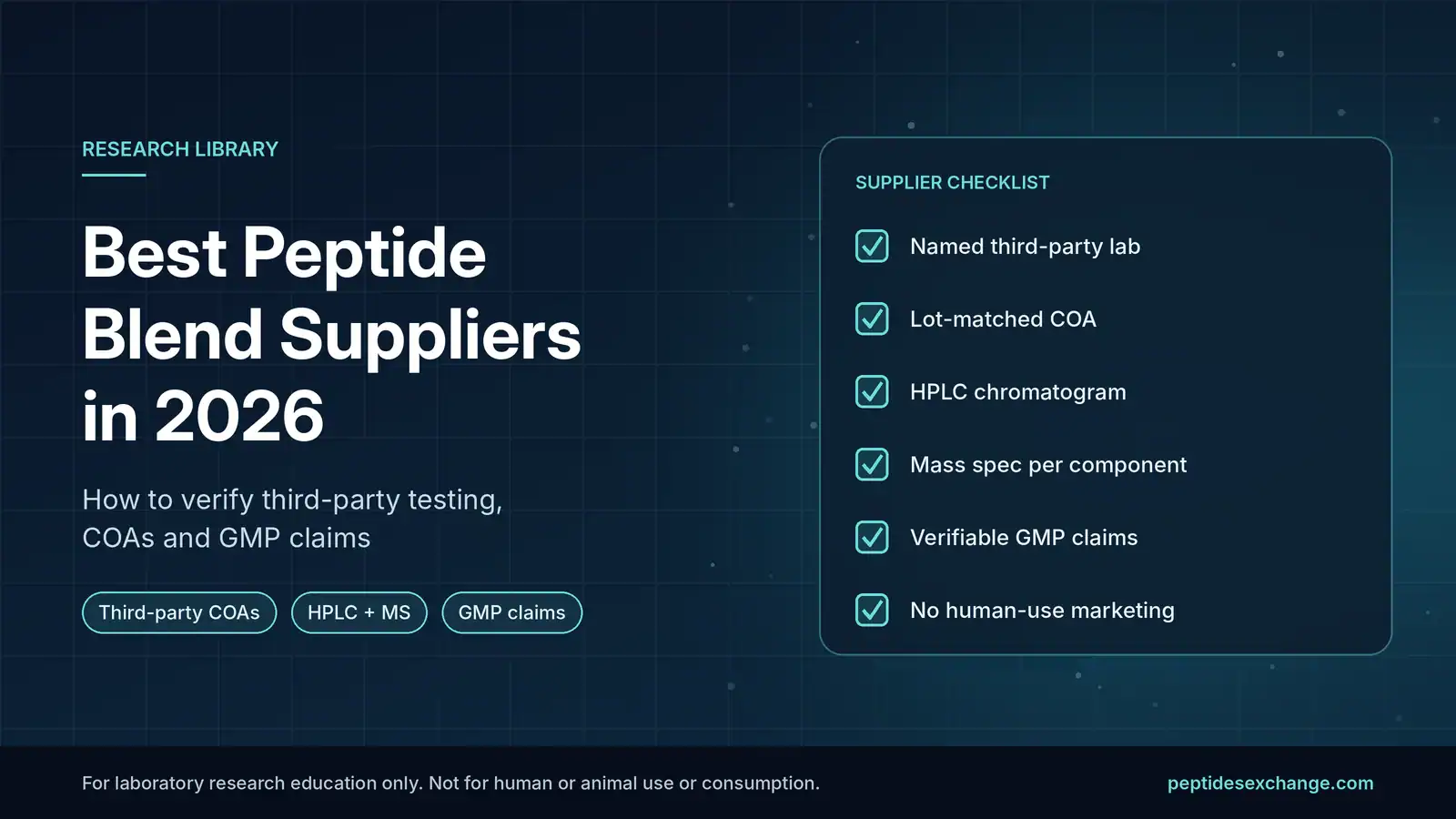
- COA names the testing laboratory, and the lab can be contacted
- Lab is independent of the seller
- COA lot number matches the vial label
- Test date is recent and matches the current batch
- HPLC chromatogram is included, not just a percentage
- Mass spectrometry confirms the identity of every component
- Blend COAs report each component separately
- Any GMP claim names the facility and who verified it
- Product pages contain no dosing, injection, or health claims
- Supplier’s name doesn’t appear in FDA’s warning-letter database
Frequently Asked Questions
Who are the best peptide blend suppliers in 2026?
The best supplier is one whose claims you can verify: named third-party lab, lot-matched COAs, mass spectrometry for every blend component, and compliant marketing. Use the checklist above on any supplier you’re considering, including us.
Why doesn’t this article rank other suppliers?
Because we’re a supplier ourselves. A ranking we publish couldn’t be independent, and the FTC prohibits presenting company-controlled reviews as independent. We’d rather give you the criteria.
What makes a peptide blend COA trustworthy?
A named, contactable lab; a lot number matching your vial; a recent test date; an HPLC chromatogram; and mass-spectrometry results for each component.
Does “GMP-verified” mean a peptide is pharmaceutical grade?
Not necessarily. Ask who is GMP-compliant, who verified it, and what it covers. Even genuine GMP manufacturing doesn’t make a research peptide an approved drug.
Does “research use only” labeling make a supplier compliant?
No. FDA evaluates a supplier’s overall marketing. Dosing, injection guidance, or health claims can make research-labeled products unapproved drugs in FDA’s view.
How can I check whether a supplier has had FDA problems?
Search the supplier’s name in FDA’s public warning-letter database.
Related Research Library Articles
- Peptide Certificate of Analysis: How to Read a COA
- HPLC vs. LC-MS: Understanding Peptide Purity and Identity Testing
- What Are Research Peptides?
- What Are Peptides?
- What Is the KLOW Peptide Blend?
- What Is the GLOW Peptide Blend?
References
- Federal Trade Commission. Trade Regulation Rule on the Use of Consumer Reviews and Testimonials. Federal Register. 2024;89(163). govinfo.gov
- National Law Review. FTC issues final rule targeting fake consumer reviews and testimonials. August 2024. NLR
- U.S. FDA. Q7A Good Manufacturing Practice Guidance for Active Pharmaceutical Ingredients. FDA
- U.S. FDA. FDA clarifies current thinking on pyrogen and endotoxins testing. FDA
- U.S. FDA. Warning letter to Summit Research Peptides, MARCS-CMS 695607. December 10, 2024. FDA
- U.S. FDA. Warning letters database. FDA
- McDermott Will & Schulte. Client alert on FDA warning letters to online peptide sellers. 2026. McDermott
- Sheppard Mullin. FDA balances peptide policy with enforcement against unlawful peptide sellers. 2026. Sheppard Mullin
- Microbac Laboratories. What is an A2LA ISO 17025 accreditation? Microbac
Research use only. Peptides Exchange supplies research peptides and blends strictly as laboratory materials for in-vitro use by qualified professionals. They are not drugs, foods, dietary supplements, or cosmetics, and are not for human or animal use or consumption. Nothing in this article is medical or legal advice. This guide reflects information available as of November 4, 2026.
Leave a Reply