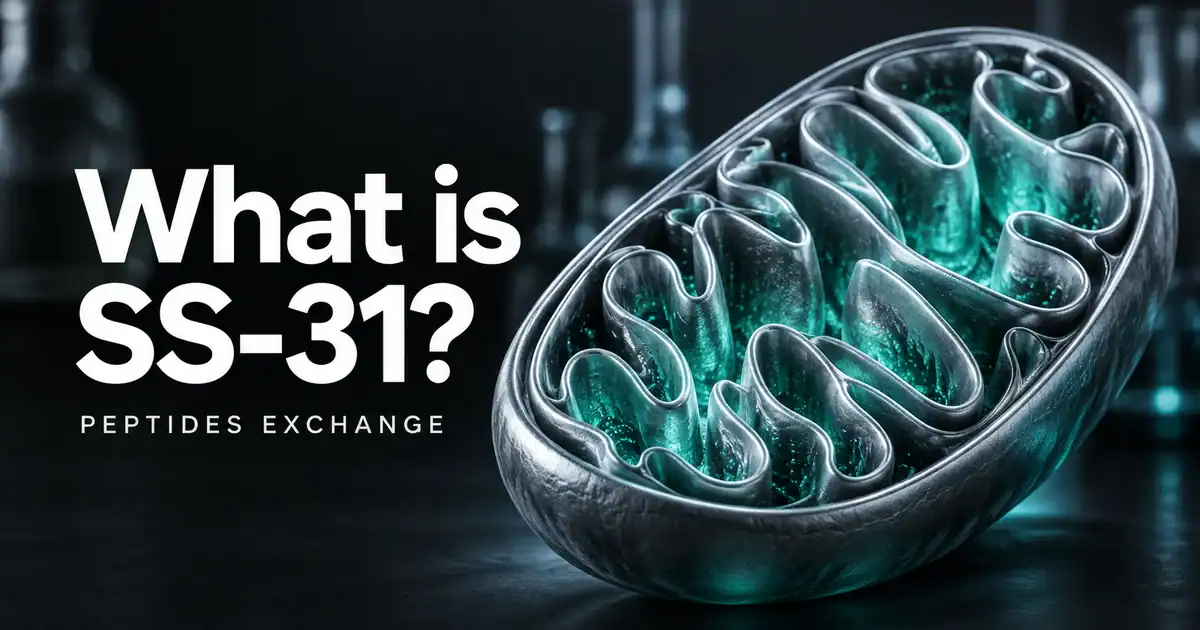
SS-31 is a synthetic peptide made from four amino-acid residues that targets mitochondria, the structures involved in producing much of a cell’s usable energy. Also known as elamipretide and the development code MTP-131, it is studied for its interactions with mitochondrial membranes and their energy-producing machinery. Research on elamipretide’s mitochondrial activity explains this focus. PMC
One of its main targets is cardiolipin, a specialized lipid in the inner mitochondrial membrane. Understanding that interaction helps explain both the scientific interest in SS-31 and the limits of claims about its effects. PubMed
SS-31 also has a specific clinical context: elamipretide is the active ingredient in Forzinity, which received accelerated FDA approval in 2025 for a defined use in Barth syndrome. That prescription approval should be distinguished from research materials sold under the name SS-31. The FDA’s approval announcement describes the decision. FDA
Understanding the SS-31 peptide
A peptide is a chain of amino acids. SS-31 is a tetrapeptide, meaning it contains four residues. Its sequence is written as D-Arg–2,6-dimethyl-Tyr–Lys–Phe–NH₂, as documented in the Forzinity prescribing information. accessdata.fda.gov
For a broader introduction to amino-acid chains and their biological roles, see our guide to what peptides are.
| Term | Meaning |
|---|---|
| SS-31 | A name used throughout the research literature |
| Elamipretide | The drug substance’s generic name |
| MTP-131 | An earlier development code |
| Tetrapeptide | A peptide containing four amino-acid residues |
| Mitochondria-targeted | Describes where the compound acts; it does not mean the peptide is naturally produced by mitochondria |
These names and the compound’s synthetic design are described in the published mitochondrial research. PMC
How does SS-31 work?
Mitochondria contain a folded inner membrane. Those folds, called cristae, help organize the machinery that produces ATP, a molecule cells use to transfer energy. Cardiolipin contributes to the structure and function of this membrane.
SS-31 research examines how interacting with cardiolipin affects that environment. A 2013 study by Birk and colleagues investigated cardiolipin binding and membrane protection using biochemical experiments and a rat model of interrupted kidney blood supply. The researchers reported preservation of mitochondrial folds and faster ATP recovery after blood flow returned. PubMed
A 2014 mechanistic study explored how SS-31 interacts with cardiolipin and cytochrome c, a protein involved in electron transport. Under the experimental conditions, SS-31 helped preserve electron-transfer activity and supported mitochondrial respiration and ATP synthesis. PubMed
These studies explain why SS-31 appears in research on:
- Mitochondrial membrane organization.
- Electron transport and ATP production.
- Oxidative damage to membrane lipids.
- Cellular responses to interrupted blood supply and other experimental stresses.
The phrase “mitochondrial protection” needs this context. Preserving a membrane measurement in an experimental model does not, by itself, establish a treatment benefit in people.
Is SS-31 FDA-approved?
Elamipretide is the active ingredient in an FDA-approved prescription medicine with a specific indication.
On September 19, 2025, the FDA granted accelerated approval to Forzinity to improve muscle strength in adults and children with Barth syndrome who weigh at least 30 kilograms. Barth syndrome is a rare genetic mitochondrial disorder. The official prescribing information defines the approved population and use. FDA
The approval relied on an improvement in knee extensor strength—the strength used to straighten the knee—as an intermediate measure considered reasonably likely to predict patient benefit. The FDA required a confirmatory trial to verify clinical benefit; continued approval may depend on that verification. FDA
This approval is specific to Forzinity and its labeled use. It does not establish that a research vial labeled SS-31 is an approved medicine, or that elamipretide has an approved use for general fatigue, athletic performance, or slowing aging.
SS-31 research: what do human studies show?
The human evidence becomes clearer when studies are examined separately. Different diseases, study designs, and outcome measures can produce different results.
Barth syndrome: randomized findings and longer follow-up
The original Barth syndrome clinical trial enrolled 12 participants in a randomized, blinded crossover study, followed by an open-label extension.
The randomized phase did not show superiority over placebo on its primary walking-distance and fatigue measures. Longer follow-up reported improvements from baseline, but those observations came from an extension in which participants knew they were receiving the drug and there was no concurrent placebo group. PubMed
The FDA’s trial summary specifically explains that the knee-strength increases supporting approval were observed during the extension. This distinction matters: a change during open-label follow-up and a benefit demonstrated against placebo are different kinds of evidence. FDA
Primary mitochondrial myopathy: a larger trial missed its main goals
The MMPOWER-3 randomized clinical trial, published in 2023, enrolled 218 adults with primary mitochondrial myopathy and compared elamipretide with placebo over 24 weeks.
The study did not meet either primary endpoint:
- Improvement in six-minute walking distance.
- Improvement in the study’s total fatigue score. PubMed
This result limits broad statements that SS-31 reliably improves stamina or fatigue. It also illustrates why findings from one mitochondrial disorder cannot automatically be applied to another.
Older adults: an ATP measurement is different from a lasting functional benefit
A 2021 randomized study in older adults enrolled 39 people aged 60–85 who were selected for low mitochondrial function.
After a single exposure, researchers observed a short-term signal in maximal ATP production capacity in a hand muscle. The percentage-change analysis reached statistical significance, while the absolute-change analysis narrowly missed the conventional threshold.
There was no significant between-group difference at day seven, and the prespecified fatigue-resistance measurement did not significantly improve.
The study is relevant to mitochondrial physiology. It does not demonstrate longer life, reversal of aging, or a sustained improvement in everyday energy. PLOS One
Heart research: laboratory tissue findings and patient outcomes
A 2019 study of human heart tissue reported improvements in certain mitochondrial measurements after failing heart tissue was exposed to elamipretide outside the body. This was an ex vivo experiment, meaning the tissue was studied after removal. PMC
In contrast, the PROGRESS-HF phase 2 trial studied 71 patients with heart failure and reduced ejection fraction. After 28 days, elamipretide did not significantly improve the primary measure of left-ventricular end-systolic volume compared with placebo. PubMed
A biological response in tissue can justify further investigation. Demonstrating that a treatment improves a patient’s health requires clinical evidence.
Does SS-31 have proven anti-aging benefits?
The studies discussed here do not establish SS-31 as a treatment that slows human aging or extends lifespan. The older-adult study measured muscle physiology, rather than longevity. PLOS One
When evaluating a claim, ask three questions: Was the research conducted in people? Did it measure an outcome that matters to daily life? Was the effect sustained and demonstrated against an appropriate comparison group?
These questions are more informative than a list of proposed benefits without study details.
SS-31 vs. MOTS-c: what is the difference?
SS-31 and MOTS-c both appear in mitochondrial research, but they have different origins and research roles.
| Feature | SS-31 | MOTS-c |
|---|---|---|
| Origin | Synthetic peptide | Peptide identified from a short sequence within mitochondrial DNA |
| Length | Four amino-acid residues | Sixteen amino-acid residues |
| Main research focus | Cardiolipin-associated membrane biology and mitochondrial function | Metabolic signaling and cellular responses to metabolic stress |
The original MOTS-c discovery study describes its mitochondrial genetic origin and metabolic effects in experimental models. SS-31’s cardiolipin-related activity is described in the mechanistic literature. PubMed
Their shared connection to mitochondria does not make their effects interchangeable or establish a benefit from combining them.
For more background, read our article on MOTS-c research involving metabolism, exercise, and aging.
What is known about SS-31 safety?
Safety findings depend on the formulation, population, and conditions being studied.
The Forzinity prescribing information identifies injection-site reactions as common adverse reactions and reports serious hypersensitivity reactions. It also describes considerations for patients with impaired kidney function. accessdata.fda.gov
These findings come from the clinical development and use of the prescription formulation. They do not establish the safety of research materials or combinations discussed outside those studies. A peptide’s short length or mitochondrial target is not sufficient evidence that it is harmless.
Research materials, testing, and certificates of analysis
Interpreting a study also requires understanding what material was tested. A named peptide, a research sample, and a finished prescription medicine should not be assumed to have identical quality controls or intended uses.
Our guide to research peptides and laboratory applications explains this context.
Analytical documentation and clinical evidence answer different questions. A certificate of analysis can report results for a tested sample. It cannot establish that the sample produces a therapeutic benefit in people.
For a closer look at documentation, see:
- How to read a peptide certificate of analysis.
- HPLC vs. LC-MS: understanding peptide purity and identity testing.
When reviewing a COA, check which sample was tested, who performed the analysis, which methods were used, and what the results actually measure. Avoid treating a purity percentage as proof of clinical effectiveness.
Frequently asked questions
Is SS-31 the same as elamipretide?
SS-31 is a research name for elamipretide. Forzinity is a specific prescription formulation containing elamipretide. The names are connected, but a research product should not be assumed equivalent to that finished medicine. PMC
Is SS-31 naturally produced by the body?
SS-31 is synthetic. “Mitochondria-targeted” describes its site of action. MOTS-c, by comparison, was identified as a peptide encoded within mitochondrial DNA. PMC
Does SS-31 improve energy?
ATP measurements do not establish that SS-31 reliably improves everyday energy. The older-adult study and MMPOWER-3 trial illustrate the difference between a physiological measurement and a demonstrated functional benefit. PLOS One
Is a research-use SS-31 product interchangeable with Forzinity?
No equivalence should be assumed from the peptide name alone. Forzinity’s approval covers a particular finished prescription product and indication; a research-use label does not establish pharmaceutical equivalence or suitability for medical use.
This article reviews published science for educational purposes. It does not provide medical advice or instructions for administering research materials. Research-use products are not intended for human or veterinary use.
Sources and further reading
- FDA, 2025. Accelerated approval announcement for Forzinity.
- FDA, 2025. Forzinity prescribing information.
- FDA. Forzinity Drug Trials Snapshot.
- Birk et al., 2013, Journal of the American Society of Nephrology. SS-31, cardiolipin, and mitochondrial recovery after ischemia.
- Birk et al., 2014, British Journal of Pharmacology. Cardiolipin, cytochrome c, electron transport, and ATP synthesis.
- Thompson et al., 2021, Genetics in Medicine. Randomized Barth syndrome trial and open-label extension.
- Karaa et al., 2023, Neurology. MMPOWER-3 randomized clinical trial.
- Roshanravan et al., 2021, PLOS ONE. Randomized study of mitochondrial ATP production in older adults.
- Chatfield et al., 2019, JACC: Basic to Translational Science. Elamipretide in human heart tissue studied outside the body.
- Butler et al., 2020, Journal of Cardiac Failure. PROGRESS-HF phase 2 trial.
- Lee et al., 2015, Cell Metabolism. Original MOTS-c discovery and metabolic research.
Leave a Reply